
USAFA Realigns Academic Enterprise and Creates Academic Wing
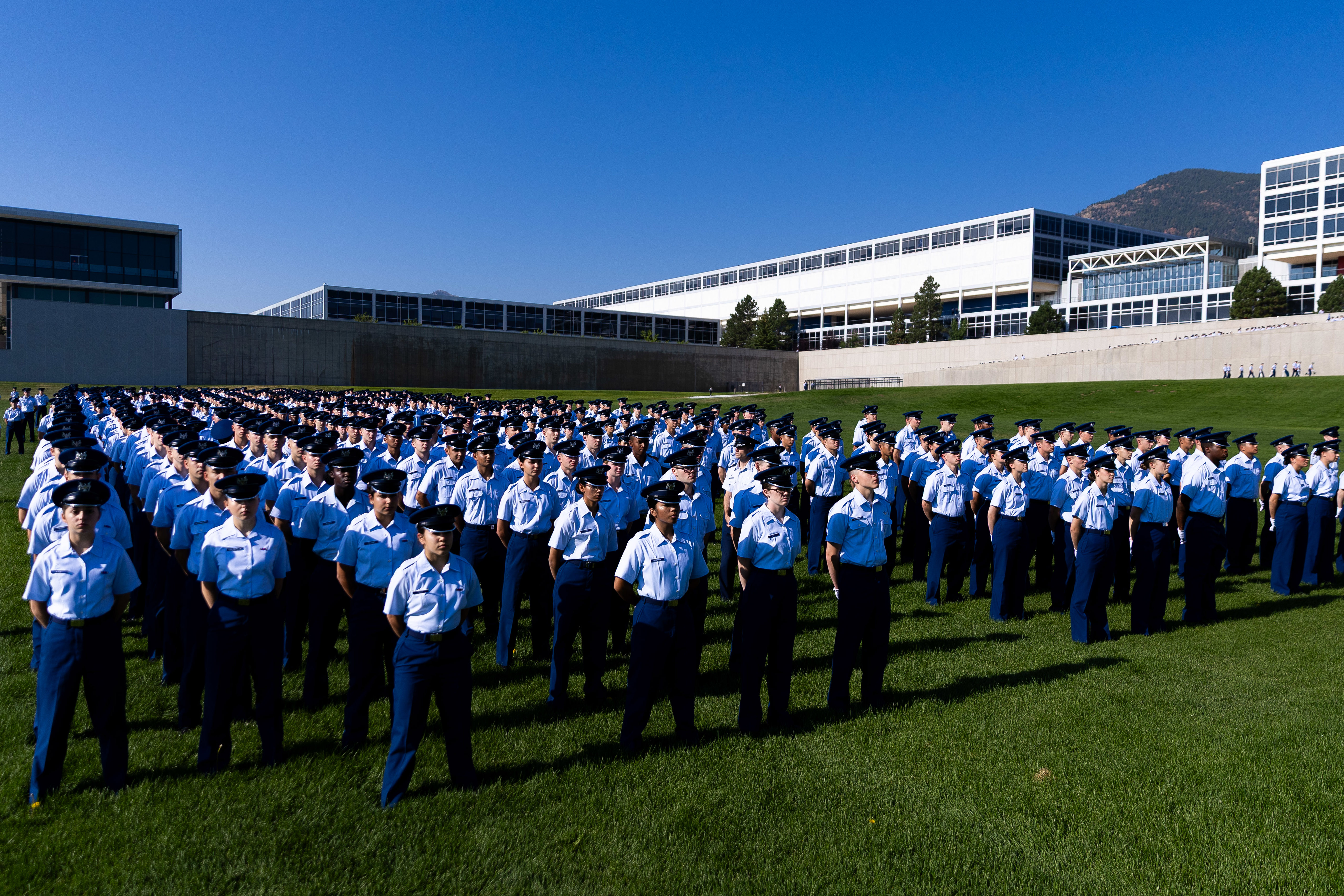
The U.S. Air Force Academy held a ceremony on Aug. 5 marking the establishment of the Academic Wing and four schools within it: the School of Integrated General Studies, the School of Integrated Basic Sciences, the School of Integrated Engineering and the School of Integrated Humanities and Social Sciences. Each school is led by a dean.
The ceremony included remarks from Academy senior leaders, including then-Academy Superintendent Lt. Gen. Tony D. Bauernfeind ’91 and Provost Brig. Gen. James M. Valpiani ’04, who focused on why USAFA is evolving its academic program. Following are Gen. Valpiani’s remarks at the ceremony:
Gen. Bauernfeind, fellow mission unit leaders, distinguished guests, members of the faculty and staff, family and friends, welcome and thank you for participating in this historic ceremony.
Gen. Bauernfeind, thank you for the confidence you have placed in me, in the leaders about to assume leadership of these new schools, and in the faculty’s commitment to educating our future officers with excellence.
Fellow mission unit leaders, thank you for your support for this reorganization. The faculty and I remain grateful to be your partners in this incredibly important mission.
And to my family: Thank you for putting up with my late nights and long weekends to support this noble mission. What an incredible and meaningful journey we’re on together — I love you.
Today, the dean of the faculty assumes the additional duties of provost and commander of the Academic Wing, and we activate four schools within it. This new structure exists for one reason: to ensure that cadets and future officers receive the education our nation requires and our service deserves.
Seventy years ago this week, on the 1st of August, 1956, Col. Robert McDermott became dean of the faculty. At that time, every cadet took the same courses in the same sequence. The education was coherent but lacked sufficient depth. McDermott understood that the Air Force would need officers with both breadth and depth in a specific field. He established the Academy’s first majors, and generations of faculty have built upon that foundation.
Over time, however, responsibility for the coherence of the entire education became diffuse, due in part to a lack of an institutional home for the core curriculum.
At the same time, the profession of arms has become more complex. The lieutenants we commission today will not receive the world in departmental categories. An officer employing artificial intelligence may face challenges in engineering, probability, strategy, law, and ethics at the same moment. The problems our graduates encounter will not arrive with disciplinary labels. They will arrive whole, complex, at speed, with lives depending upon their judgment.
As McDermott grasped, our graduates must master a discipline. But first, they must understand how different forms of knowledge fit together and how to bring them to bear upon complex warfighting problems.
Our task today is to honor the wisdom of McDermott’s vision while restoring the education to a more deliberate whole. That is the purpose of these new schools.
The School of Integrated General Studies assumes responsibilities for the common education shared by every graduate. Dr. Jensen, your extensive experience educating cadets in some of the most challenging and formative material this Academy offers, and your demonstrated excellence in integrating across disciplines, make you an ideal inaugural dean for this new endeavor. You are taking on an incredible responsibility, integrating and reimagining the core curriculum which prepares all of our cadets for the demands of officership. Your experience, breadth and depth of knowledge, collegiality, and practical wisdom have prepared you to lead the most important element of the academic mission.
The School of Integrated Basic Sciences will advance disciplined inquiry about the natural world through mathematics and science, which our cadets must master across the air and space domains. Col. Hasstedt, you carried our faculty through a consequential transition as acting dean with equanimity, steadfast judgment and a great sense of humor. Our institution is fortunate to have your leadership, and I am grateful to benefit from your continued counsel and wisdom in service to our cadets and faculty.
The School of Integrated Engineering will advance disciplined inquiry about the made and virtual world through the practices of engineering and computer science, which our cadets must master to develop and field war winning capabilities across all our warfighting domains. Col. Gresham, your extensive experience in test and evaluation have given you the ability to lead a transformation in our technical disciplines, providing cadets with hands-on, mission-oriented experience alongside education in the rapidly evolving world of artificial intelligence. Under your guidance, our graduates will learn foundational theory and wield AI more wisely and effectively than our adversaries.
The School of Integrated Humanities and Social Sciences will unite the disciplines through which cadets study human nature, history, language, law, government, society, and war. Col. Martin, your extensive experience and knowledge of all aspects of the USAFA mission, in addition to your leadership as a command pilot and department head, make you exceptionally well qualified to bring together the humanities and social sciences into a coherent whole. Your leadership will ensure our cadets deeply understand the Western tradition that they are inheriting, the constitutional order that they have sworn an oath to defend, and the perspectives of our allies and competitors, so that they can effectively sustain a just peace through wise diplomacy and dominant military strategy.
Each school now brings together academic leadership and command authority. To the deans who will exercise that leadership, I charge you with four responsibilities.
First, lead well.
Build strong and healthy organizations in which people know what is expected, are treated with dignity, and are held to meaningful standards. Implement mission command, empowering your subordinates via decentralized execution and freedom of action based on clear commander's intent. Foster a climate of trust in which faculty and staff can speak candidly and disagree professionally, then execute with discipline and energy. Exercise authority with humility and respect for the role of faculty in shared academic governance.
Second, drive integration. This is the distinctive work for which these schools have been created.
Drive it culturally and structurally. Build sequences in which one course prepares cadets for the next and knowledge gained in one field is deliberately employed in another. Cadets should see why an engineer must think about ethics, why a strategist must understand technology, and why history and political philosophy matter to those entrusted with military power.
Third, keep every school aimed at the mission.
The education offered here must be unmistakably the education of the United States Air Force Academy, ordered to forming officers whose distinctive habits of thought uniquely prepare them for the demands of modern war and peace.
Fourth, uphold a high standard of excellence.
The Academy attracts the nation’s finest young men and women eager to serve their nation. Set the bar high, knowing that they will exceed all expectations, and confident in the power of education to transform cadets into the citizens, leaders, warfighters, and scholars our nation expects and our services deserve.
In 1956, Col McDermott recognized that the Academy’s education must evolve to meet the demands of his day. Today, we honor his vision and conviction by establishing the Academic Wing and the four integrated schools, to ensure cadets are ready for the complexities of conflict in our day.
Mark, Steve, James, and Meg — it’s an honor to share this stage with you. Let’s activate these new schools.
Editor's note: The U.S. Air Force Academy Association & Foundation thanks the Academy and Gen. Valpiani for allowing us to publish his ceremonial remarks. Find more information in the “Final Word” section of the September issue of Checkpoints.