
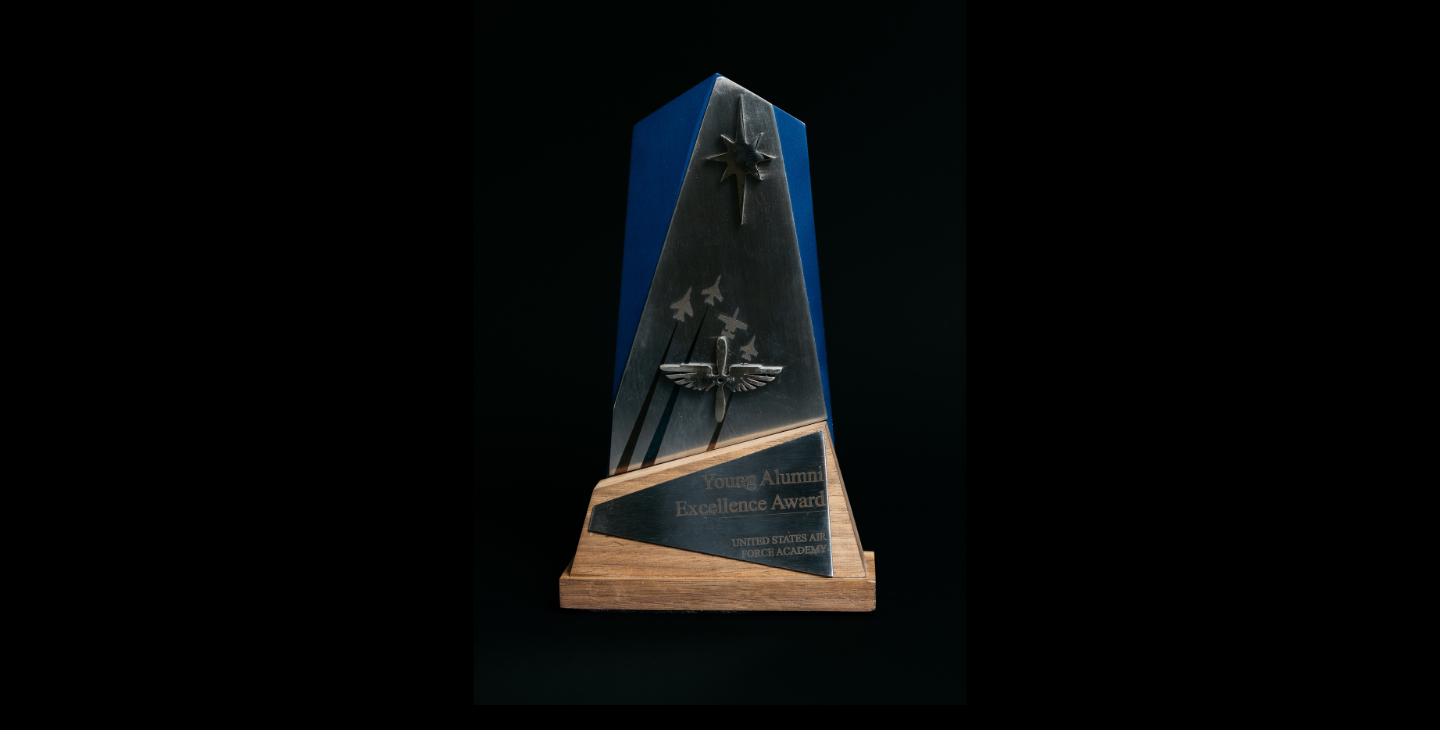
Checkpoints: Exemplifying Excellence - Young Alumni Excellence Award
Maj. (Ret.) Andrew Van Timmeren ’10
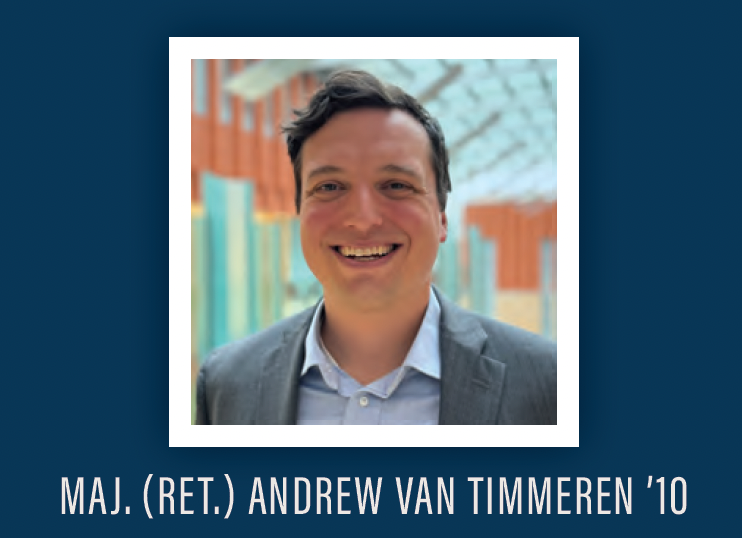
Maj. (Ret.) Andrew Van Timmeren ’10 traces the start of his career back to a moment he can’t fully explain. Growing up in western Michigan with no military background, he woke up one morning in seventh grade certain of two things: He wanted to fly airplanes, and he wanted to attend the U.S. Air Force Academy.
“I couldn’t tell you how I even knew the Air Force Academy was a thing,” Van Timmeren says. “I chalk it up to a calling.”
From there, the right people seemed to appear at the right time. His high school guidance counselor, whose son had attended USAFA, helped Van Timmeren prepare academically, and his father supported him through the application process. When Van Timmeren earned an appointment, his swim coach surprised him with the news at senior night.
However, his certainty wavered soon after he arrived at the Academy. During the first week of basic cadet training, overwhelmed by the environment, Van Timmeren met with a chaplain to discuss leaving. The chaplain advised him to finish basic training before deciding. “That unlocked the competitor in me,” Van Timmeren says. “I decided to stay, and that was a meaningful turning point in my life.”
He arrived as a recruited water polo player but eventually stepped away from the team after discovering soaring. Flying gliders gave him both an escape from the demands of cadet life and the foundation for his future career. He soon became a soaring instructor pilot.
As an instructor, he learned to remain calm, adjust when plans changed and take responsibility for another person in the aircraft. The experience mattered so much that he had the soaring patch engraved inside his class ring. “I feel like I was a better Raptor pilot because I flew gliders,” he says.
Van Timmeren also served as Cadet Wing commander during his final semester, leading more than 4,000 cadets. The role taught him to set a vision, communicate clearly and empower others. More importantly, it reinforced a lesson that shaped every stage of his career: You can’t have leadership without a relationship.
After graduating with a degree in political science, Van Timmeren attended pilot training at Vance Air Force Base, Oklahoma. On a mentor’s advice, he placed the F-22 Raptor at the top of his preference list, although he believed it was unlikely. He was selected for the aircraft and went on to serve as an operational, instructor and evaluator pilot.
In 2014, he deployed to the Middle East as ISIS gained ground in Syria and Iraq. During the deployment, he and another Academy graduate flew the first daytime F-22 combat sortie. He later participated in the Raptor’s first deployment to Europe and returned to train future pilots.
His understanding of leadership deepened after Hurricane Michael struck Tyndall Air Force Base, Florida, in fall 2018. Van Timmeren’s home was damaged, and the 46 people he led were scattered during evacuations, many unsure whether their homes still stood. The experience stripped leadership down to its most basic purpose: caring for people. “Nobody’s talking about the peak of Maslow’s hierarchy of needs if I don’t know where I’m living tonight because my house is gone,” he says.
Around the same time, Van Timmeren began experiencing double vision. After moving to Joint Base Langley-Eustis, Virginia, he reported the symptoms and was grounded, which led to his medical retirement at age 32.
The unexpected end of his flying career opened another path. While serving in a staff role, he attended a briefing from Blue Force Technologies about developing a high-performance unmanned fighter. The concept immediately captured his attention.
After retiring and moving his family back to Michigan, Van Timmeren joined the company and helped lead its autonomous aircraft efforts. Blue Force Technologies was later acquired by Anduril Industries, but Van Timmeren continued to lead work related to the Collaborative Combat Aircraft program. In 2025, the team’s Fury aircraft completed its first flight, a professional milestone he ranks just behind flying fighters.
Receiving the Young Alumni Excellence Award surprised and humbled Van Timmeren. He sees the recognition as part of a throughline that began at the Academy and spans the relationships that have guided him. “The foundation was laid at the Academy,” he says. “I can’t be more proud.” Today, Van Timmeren is an executive at Astro Mechanica, helping develop another autonomous aircraft. Though he wears a different uniform, he remains focused on supporting the fight. “The only thing I wanted to do, whatever the job, was still make an impact on my friends,” he says.
Lt. Col. Jeffrey Michael Allen ’11
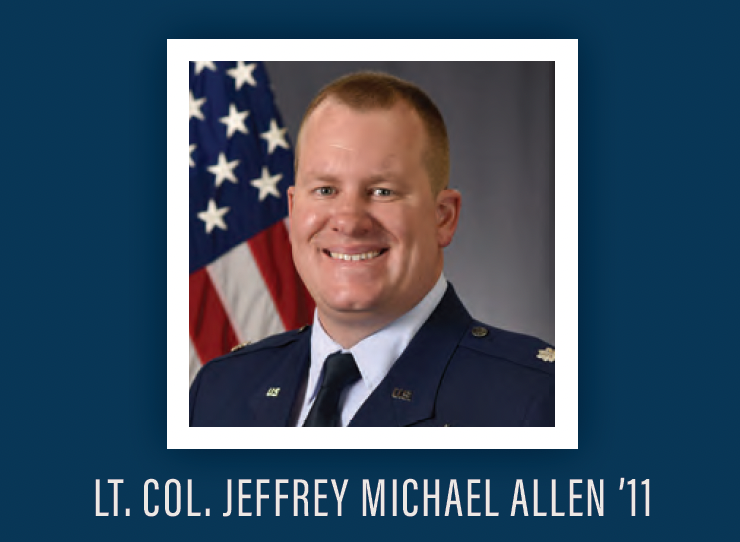
Lt. Col. Jeffrey Michael Allen ’11 learned early that service is measured less by the uniform someone wears than by the way they care for others. Growing up in an Air Force family, Col. Allen watched his father serve first as an enlisted airman and later as a career civilian.
“He has been my role model since I was young and is the primary reason I joined the Air Force,” Col. Allen says of his father. “Watching him serve for nearly 40 years taught me that leadership is about service, humility and taking care of people.”
Col. Allen’s interest in leadership developed through Air Force JROTC and participation in scouting, where he earned the rank of Eagle Scout. With military service already in his sights, he considered ROTC, but attending the U.S. Air Force Academy quickly became his goal. Col. Allen studied political science at USAFA, and he jokingly describes “operation graduation” as his primary extracurricular activity.
The Academy’s demanding combination of academics, military training and physical requirements tested his ability to manage time and perform under pressure. Basic cadet training pushed him beyond what he thought he could handle, while Commitment Day reinforced his decision to serve. As an upperclassman, Col. Allen began developing the leadership style he continues to refine today.
“Graduation wasn’t the finish line — it was the starting line,” he says. “The Academy had prepared me, and it was finally time to earn the privilege of leading airmen.” That responsibility came soon after graduation. On his first day of active duty, Col. Allen became a flight commander overseeing 45 airmen before attending technical school. The experience set the tone for a career spanning munitions maintenance, aircraft maintenance and logistics. Across each assignment, one principle remained constant: Take care of your airmen, and they’ll take care of the mission.
Col. Allen carried that philosophy into command. In Europe, he led the Air Force’s only surety-capable maintenance squadron, responsible for conventional aircraft maintenance, war reserve material, munitions storage and aircraft recovery operations supporting U.S. European Command.
He later commanded the 18th Munitions Squadron at Kadena Air Base, Japan, leading a multinational team responsible for the Air Force’s largest munitions storage area and one of its largest war reserve munitions stockpiles. The squadron supported joint and allied operations throughout the Indo-Pacific. Although the missions were technically complex and strategically important, Col. Allen says command was ultimately about people.
“As a commander, I wasn’t the tip of the spear — my airmen were,” he says. “My responsibility was to sharpen the spear by ensuring they had the resources, training and support they needed.” His units consistently earned recognition for excellence, which Col. Allen attributes to training, discipline and a strong team identity. He believes leaders set an organization’s climate and, over time, that climate becomes its culture.
“The Air Force already gives us incredible airmen and civilians,” he says. “My job as a leader isn’t to find great people; it’s to develop them.”
Mentorship has remained central to that effort. Col. Allen encourages young officers to seek guidance from every level of an organization, noting that some of his most valuable lessons came from enlisted airmen. He sees investing in others as a responsibility owed to those who invested in him.
That commitment extends beyond the Air Force. Col. Allen has volunteered over 1,400 hours with Scouting America, helping develop young leaders in Montana, Florida and Italy. More recently, he became involved with the 501st Legion, which supports charitable causes and local communities. “Leadership doesn’t end when you take off the uniform,” he says. “Service isn’t defined by the uniform you wear; it’s defined by your commitment to improving the lives of others.”
Receiving the Young Alumni Excellence Award was an honor Col. Allen never imagined as a cadet. He views the achievement as recognition of the mentors, family members, supervisors and airmen who helped shape him. “You helped transform a know-it-all second lieutenant into the officer I am today,” he says. “Thank you for seeing my potential and taking the time to help me become the officer I am today.”
For Col. Allen, being counted among the Long Blue Line carries both honor and responsibility. He believes graduates must uphold the legacy of those who came before them while preparing those who will follow. This summer, Col. Allen began a new assignment with the Department of Energy’s National Nuclear Security Administration. He now serves as a section leader for the Department of Energy’s Nuclear Emergency Support Team. Although the mission differs from previous assignments, his goal remains unchanged: care for the people he leads, accomplish meaningful work and leave every team stronger.
Lt. Col. Carmilya Jones ’11
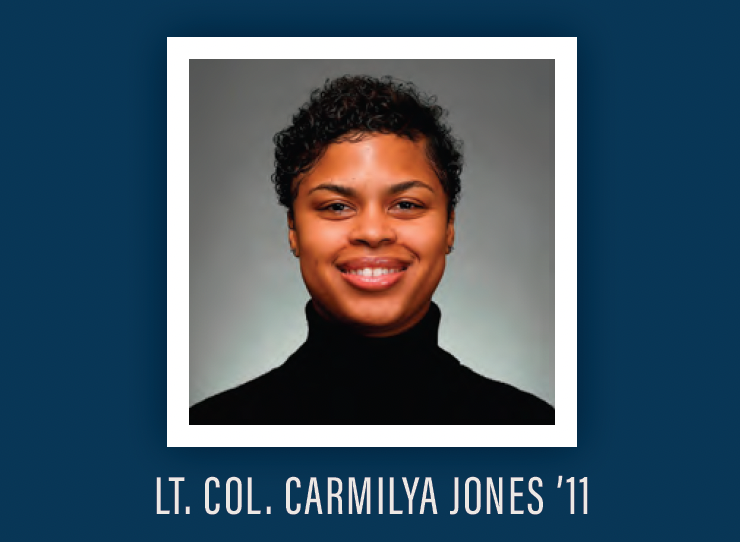
The answer was “no,” but Lt. Col. Carmilya Jones ’11 wasn’t ready to give up on her dream of attending the U.S. Air Force Academy, wearing the uniform and serving her country. She didn’t come from a military family, but growing up in Fayetteville, North Carolina, Col. Jones was surrounded by service members. Her mother worked as a civilian graphic designer at Pope Air Force Base, North Carolina, and by middle school, Col. Jones knew she wanted to wear the uniform.
She joined JROTC and soon became the unit commander at her high school. After her junior year, her mother encouraged her to apply to an aviation camp. That application introduced Col. Jones to USAFA, and she knew she wanted to attend. Although she prepared academically and completed her application, her first attempt didn’t result in an appointment.
Instead of giving up, she drove two hours to attend a Service Academy Day, where she met admissions liaison officer Col. Dionne Flynn ’95. Col. Flynn helped Col. Jones strengthen her application, improve her test scores and navigate the nomination process. The effort paid off when she earned an appointment to attend the U.S. Air Force Academy Preparatory School.
The Prep School gave Col. Jones confidence before arriving at the Academy, where she embraced opportunities to lead while serving as manager of the women’s volleyball team, manager of the men’s basketball team and president of the Way of Life Committee.
During her fourth-class year, Col. Jones’ air officer commanding, Lt. Col. Darlene Cheatham, advocated for Col. Jones during a difficult encounter with an instructor. The experience showed Col. Jones firsthand the impact a leader can have. From then on, she told herself: “I am going to be that type of leader. If I can advocate for somebody in a way that can lead to a lifetime of service, why not?”
After graduation, she spent a year recruiting prospective cadets through the Academy’s Gold Bar program before going on to train as a nuclear missile operator and serve at F.E. Warren Air Force Base, Wyoming. She later transitioned into space operations, becoming a GPS operator, instructor and evaluator at Schriever Space Force Base, Colorado.
As the U.S. Space Force stood up in 2020, Col. Jones chose to transfer into the new service. She later helped establish the Space Force’s watch cell at the Pentagon, supporting senior leaders during the opening months of the Russia-Ukraine war and helping demonstrate the critical role space capabilities play in modern military operations. Her career continued to expand into strategic and policy-focused assignments, and she was twice recognized among the top 3% of headquarters-level officers. She’s served as executive officer to several senior Space Force leaders, including Lt. Gen. B. Chance Saltzman, and completed a legislative fellowship, working in the Department of Justice and in the office of Colorado Sen. Michael Bennet. Today, she serves as a legislative liaison at the Pentagon, preparing the Department of the Air Force’s senior leaders for congressional hearings and engagements.
Although her assignments have ranged from missile silos to Capitol Hill, Col. Jones says each experience has added a new dimension to her leadership style. She credits another mentor, Lt. Col. John Powell, with teaching her to become a stronger leader through challenging experiences, including asking her to represent him before senior leaders while she was still a captain. “Knowing that he had trust in me made me trust myself,” says Col. Jones, adding she now strives to build that same confidence in those she leads. “I want people to experience it for themselves,” she says. “Most times we struggle with the ‘why’ because we didn’t get the experience.”
Col. Jones continues to serve as an admissions liaison officer, helping prospective cadets pursue the same opportunity that changed her life. Outside of work, she serves in her church, volunteers with Jack and Jill of America to help develop future leaders through service and philanthropy, and remains active in the Way of Life affinity group. She and her husband, Steve, a Class of 2012 graduate and Space Force officer, have two children.
Receiving the Young Alumni Excellence Award came as a surprise to Col. Jones. “I don’t believe it,” says Col. Jones. “I’m just a little girl from Fayetteville, North Carolina, that didn’t even get into the Academy the first time.” Being part of the Long Blue Line, she says, means belonging to a community united in its commitment to service. She views this recognition as less about her individual achievement than about the people who invested in her along the way. “If someone didn’t help me get into the Academy, I don’t think I would be here,” says Col. Jones.
Looking ahead, Col. Jones hopes to become a squadron commander, but her purpose and goals remain unchanged: to help people, create opportunities for others and leave every organization stronger than she found it.
Sam Eckholm ’18
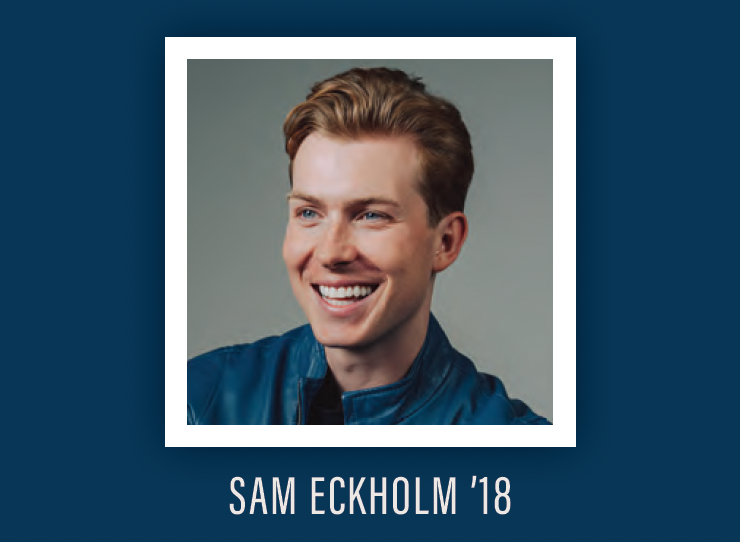
At age 15, Sam Eckholm ’18 searched YouTube for a glimpse of life at the U.S. Air Force Academy. He found very little content and few answers to his questions.
Fortunately, Eckholm had personal sources of information, including his father, a Class of 1989 graduate and former KC- 135 pilot, and his uncle, a Class of 1993 graduate. Their stories introduced him to the Academy’s challenges and opportunities, but Eckholm knew that many prospective cadets didn’t have that connection. He made himself a promise: If he earned an appointment, someday he would create the videos he wished he had found when searching YouTube for information.
Growing up in Dallas, Texas, Eckholm admired his father but says he was never pushed toward military service. When he expressed interest in USAFA, his father encouraged him to understand exactly what the commitment required.
During basic cadet training, letters from his father helped him persevere. As Eckholm adjusted to life at USAFA, he embraced opportunities that ultimately shaped his future, including volunteering as an Academy ambassador, starting an Instagram account for his cadet squadron and developing an interest in photography. He also joined the mock trial team, which led him to major in legal studies and strengthened his public speaking skills.
As Eckholm progressed at USAFA, he carried on a family legacy by moving into CS-28, his father’s and uncle’s former squadron. Seeing their names on the graduate plaques deepened his connection to the Blackbirds. During his final semester as a firstie, he served as squadron commander, leading more than 100 peers. “That was probably, even to this day, the most responsibility, the most stressful pressure and the most rewarding opportunity that I’ve had,” Eckholm says.
An Operation Air Force assignment to Travis Air Force Base, California, introduced Eckholm to public affairs. The combination of storytelling, media and military service immediately appealed to him. As graduation neared, he competed for one of the few public affairs assignments available and began his career at Joint Base Langley-Eustis, Virginia.
As a second lieutenant, Eckholm earned a position with the F-22 Raptor Demonstration Team. For two years, he traveled nearly 300 days annually, managing social media, photography, video, media outreach and community engagement. During his tenure, the team’s Instagram audience grew from about 16,000 followers to nearly half a million. The experience taught him how to tell military stories that resonated with broad audiences.
In 2020, he began producing his own videos about the Academy, aviation and military service — a way to fulfill the promise he made as a teenager. His Academy tour video has attracted nearly 3 million views since its 2023 release and is often among the first results prospective cadets see when searching for USAFA online.
After completing his active-duty commitment in 2023, Eckholm turned his growing platform into SE Media, a San Franciscobased production company. What began as a one-person operation has since expanded to include producers, editors and videographers.
SE Media’s flagship series, Access Granted, takes viewers inside aircraft, military units and industries that are often difficult to understand or access. Productions often require six months to a year of coordination, filming and security reviews. Amid SE Media’s success and bright future, Eckholm still considers himself a guide rather than the main subject. “I’m the host; I’m not the story,” he says. “My role is to help translate this, put it into perspective, bring the audience along and connect the dots.”
Eckholm says the stories belong to the airmen, service members, engineers and innovators whose work he highlights. He says the most meaningful responses come from people inspired to serve, military members who can show their families what they do, and families who better understand their loved ones’ missions. Leading a growing company has reinforced the lessons he first learned as a cadet. He focuses on building teams around a shared purpose, leading from the front and accepting that no leader can please everyone.
Receiving the Young Alumni Excellence Award was especially meaningful because it came from the institution that shaped him and helped launch his journey. “Everything I built started at the Academy,” Eckholm says. “I’m very proud, very honored and excited to represent the Long Blue Line.” Indeed, Eckholm encounters the Long Blue Line nearly everywhere he travels. Academy graduates appear in the units he visits, the companies he works with and the audiences he reaches. Each connection reinforces the network’s shared commitment to service and to supporting one another.
Looking ahead, Eckholm says he has some exciting new ideas for how to continue telling meaningful stories that educate, entertain and inspire even more people. “I think you will be pleasantly surprised and excited to see what those are when they come out,” he teases.