
Checkpoints: Cleared for takeoff
Hosmer Visitor Center set to launch in May
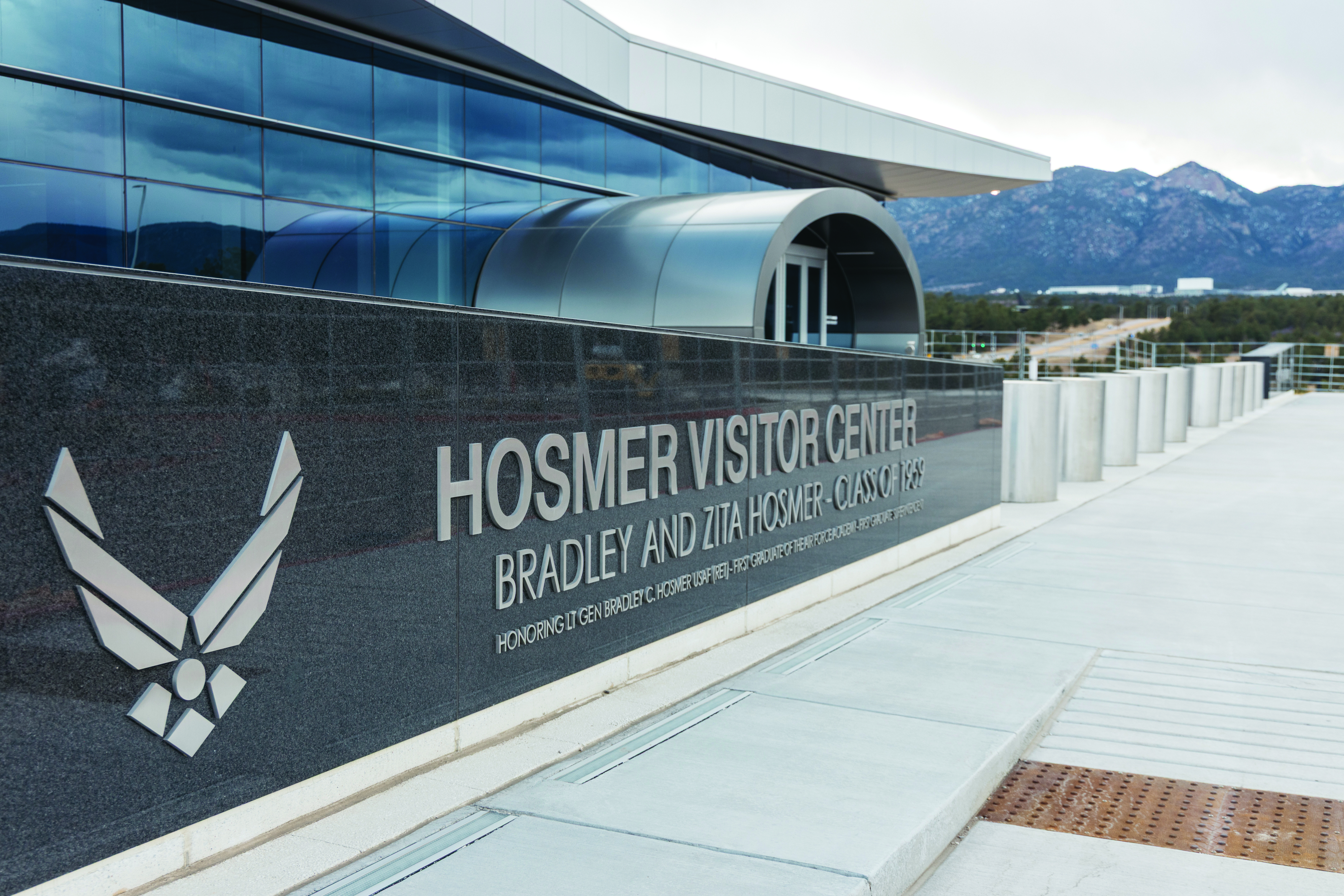
The new Hosmer Visitor Center is meant to feel familiar to those who have been to the U.S. Air Force Academy before — especially graduates. But graduate or not, every person passing through the entryway will recognize that they are standing at the threshold of one of the country’s premier service academies.
The long-anticipated Hosmer Visitor Center, an integral part of the TrueNorth Commons development, which includes Hotel Polaris, is scheduled to open outside the Academy’s North Gate in May. It has one clear mission: Tell the story of the 47-month odyssey from a basic cadet’s first uncertain steps to a life of service that extends far beyond graduation. And, just as importantly, do it in a way that feels alive to visitors.
“This isn’t a museum,” says Col. (Ret.) Mike Peterson ’87, acting deputy director of USAFA’s Strategic Communications Office. “Why is that distinction so important? I think what we’re trying to do is get away from what we have now, which has served us well since 1986, but it’s dated. It’s old, and all the visitor centers and museums that you go to now — if you’ve been to the College Football Hall of Fame, or if you’ve been to the [National Museum of World War II Aviation] — they’re high-tech, lots of digital, a lot of interactive, or a combination thereof.” Even the building's name carries its own weight and intention.

“I remember kicking around who we would name it after,” says TrueNorth Commons developer Dan Schnepf ’83, founding principal of Matrix Design Group Inc. “There were a number of names being considered, but [former Academy architect] Duane Boyle was all about [Lt. Gen. (Ret.) Bradley C. Hosmer ’59] for all the right reasons.”
Schnepf already knew and admired Gen. Hosmer from their service together on the Air Force Academy Foundation board of directors. But as he dug deeper into Gen. Hosmer’s legacy — the general was the first-ever graduate of the Academy, the first to receive a Rhodes scholarship and the first graduate to serve as USAFA superintendent (1991-94) — the choice to name the visitor center after him and his spouse, Zita, became obvious.
“When I started doing some research on his background, I was kind of overwhelmed,” Schnepf says. “And when you hear the man speak — such humility. His success and his rank have always been secondary to the mission.”
For Schnepf, naming the visitor center was not just about honoring an impactful graduate; it was also about setting the tone for everyone who walks through the door.
“A project of this magnitude with this kind of permanence — assigning it the right name was really important,” he says. “And I do think that Gen. Hosmer and his wife, Zita, were the best choice, and we thank Jerry ’70 and Pam Bruni for helping make that opportunity possible through their support and dedication to the project.”
FIRST IMPRESSIONS
For visitors to have a first impression, they first need to stop. After the Sept. 11, 2001, terrorist attacks on the nation, security changed dramatically, reducing on-base visitation. For Schnepf, the new center’s unique design and easy accessibility just outside the North Gate invites people to stop and see what the Academy is all about, serving as a critical first impression for the Academy itself.
From walking into the center throughout the whole experience, every impression is designed to be awe-inspiring. When guests first enter the building — constructed to look like an aircraft taking flight — Gallery 1 sets the tone.
According to Peterson and Lisa Neener, chief of visitor experience, guests will enter next to a staffed welcome desk, where trained “brand ambassadors” will greet them.
Just beyond the entrance, a concise introduction highlights four pioneers whose leadership proved decisive in the Academy’s founding — Brig. Gen. Billy Mitchell, Gen. Hoyt Vandenberg, Lt. Gen. Hubert Harmon and President Dwight D. Eisenhower. Their introductions give way to the story of how the Academy’s land was selected and preserved.
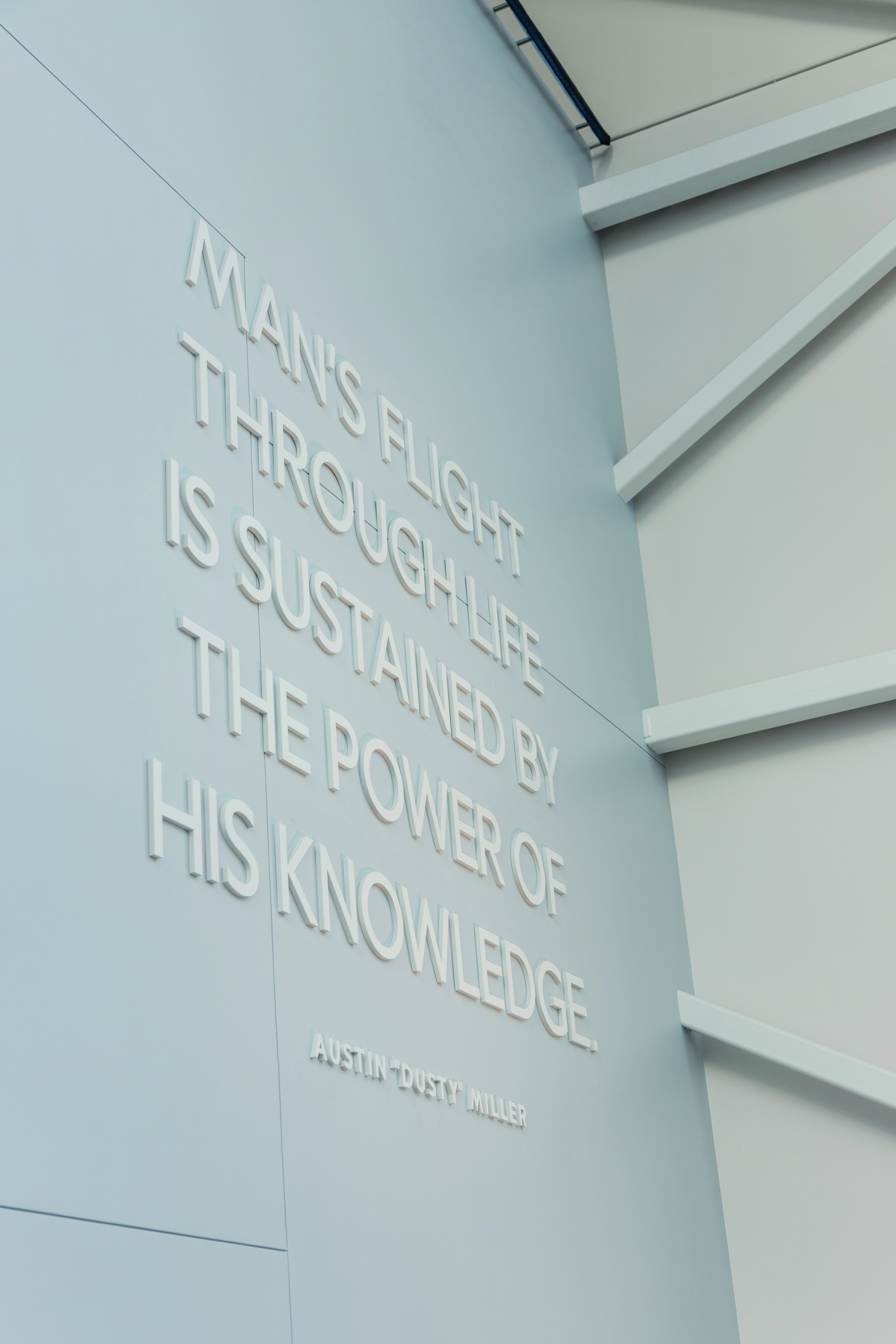
Anchoring the space is a floor-to-ceiling video wall that will play a short, looping introduction. Architectural elements — angled beams and blue wood slats on the walls and ceiling — evoke contrails. “There are beautiful beams on the side and on the ceiling to represent forward thinking and to draw people in,” Neener says.
Also in Gallery 1, visitors will find an interactive display of class crests on a touchscreen. Visitors can tap into the symbolism behind each element — why a falcon appears here, what a color signifies there; for grads, it’s a chance to reconnect with memories tied to their own class.
Gallery 2 delivers one of the most powerful moments in the building, Neener and Peterson explain. Visitors step onto footprints tiled in the class color of the incoming four-degrees. Facing the mirrored wall, visitors see the Air Force Core Values: integrity first, service before self and excellence in all we do. Offset below them are the Space Force’s values — character, connection, commitment and courage — which underscore the Academy’s evolving mission. Beside them both is the Honor Code — “We will not lie, steal, or cheat, nor tolerate among us anyone who does” — which serves as the foundation for cadet character development.
Above and around the room, a meticulously researched night sky wraps the walls, anchored by Polaris — the North Star — long a symbol of constancy and guidance at USAFA. As visitors stand on the footprints, a soundscape of cadets reciting the oath of allegiance plays overhead. “So it’s pretty serious and kind of somber,” Peterson says. “It’s going to get your attention.”
The gallery, he says, asks: Can you see yourself here? That question is at the heart of the project, Schnepf says. “I think that any visitor center is the ultimate recruiting tool … to attract the best and brightest,” he says. “That’s why we did the project.” “We wanted a draw, an attraction that would out-compete what you see at West Point and what you see at Annapolis. … I think then your foot is already in a potential recruit’s door,” he says.
A DAY IN THE LIFE
Leaving Gallery 2, visitors walk “up the ramp” into Gallery 3, passing murals of cadets on the Terrazzo and hearing encouragements — and corrections — from Academy cadre.
“Gallery 3 is one of the bigger galleries, because it’s really the nuts and bolts of the Academy,” Neener says. “It’s what creates a day in the life [of a cadet].”
Screens show short videos of basic cadet training. Nearby, mannequins display cadet uniforms, including parade dress, service dress and operational camouflage. These are the only physical artifacts in the entire building, a conscious choice that underscores the center’s focus on experience rather than display cases, Peterson says.
Interactive stations invite hands-on exploration. One lets visitors build cadet rank insignia, starting with the simple markings of a fourth-class cadet and progressing upward. As each rank appears, videos of real cadets explain the responsibilities that come with it — from learning to follow to leading cadet squadrons.
Another exhibit breaks down the daily schedule, allowing guests to select blocks of time and see how quickly a cadet’s day fills. Across the room, a scaled down but precise model of a cadet dorm room shows how space is organized and regulated. A complementary video demonstrates room preparation and inspection standards familiar to generations of graduates.
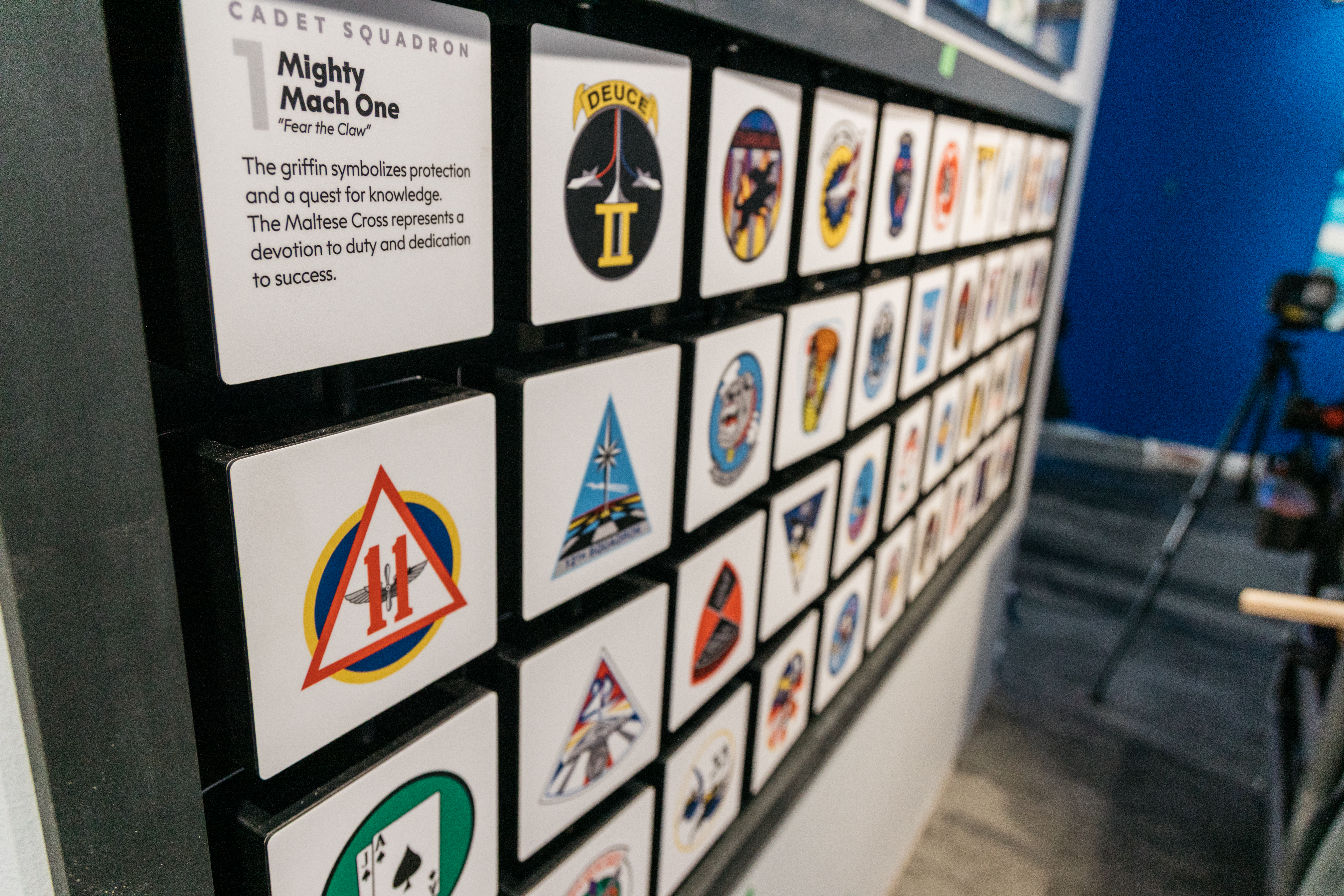
Visitors can also flip through springloaded tiles displaying the patches and mottos of the Academy’s current 40 cadet squadrons. Cadet clubs and the USAFA Prep School receive attention here as well, reinforcing that life at the Academy extends beyond the cadet area.
Gallery 4 zooms out. After an introductory space that frames the Academy’s core mission elements — academics, athletics and military leadership training — visitors enter a room dominated by towering, wing-shaped structures.
These “winglets,” rising from floor to ceiling on both sides of the gallery, house massive screens that play looping video. Each screen focuses on one mission area. Together, they show cadets in classrooms and laboratories, on athletic fields, in military training environments, and preparing for emerging domains such as cyber and space.
Early concepts centered on airmanship alone, but project and Academy leaders quickly broadened the scope. The Academy, they emphasized, prepares officers for a fight that now spans air, space, cyber and beyond.
Seating in the gallery encourages visitors to pause and absorb the content. The room is large enough to accommodate crowds, recognizing that this is where many guests will spend the most time.

GOING TO THE CHAPEL (SORT OF)
Gallery 5 opens into a soaring glass atrium, a space flooded with natural light and windows that frame sweeping views of the Front Range.
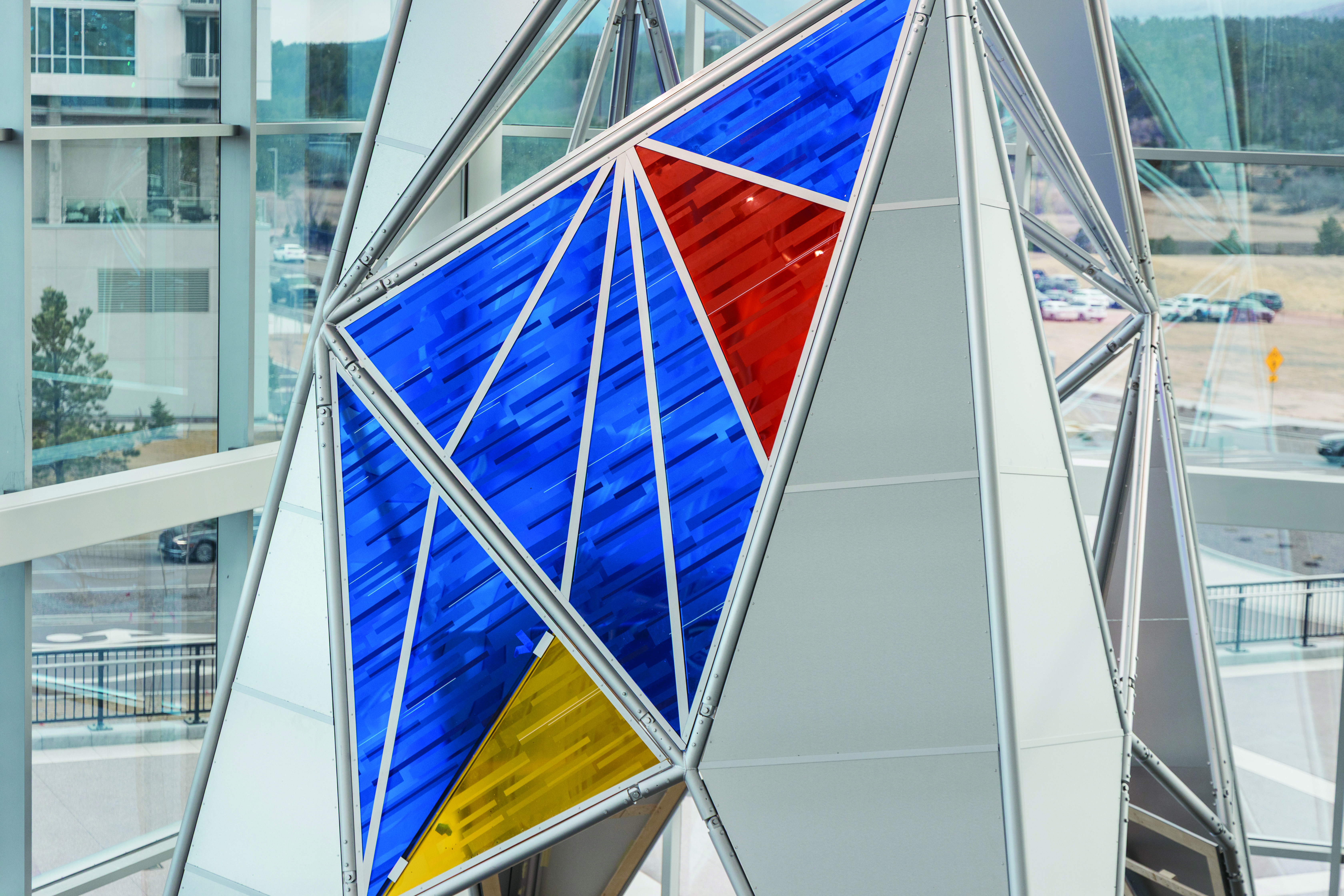
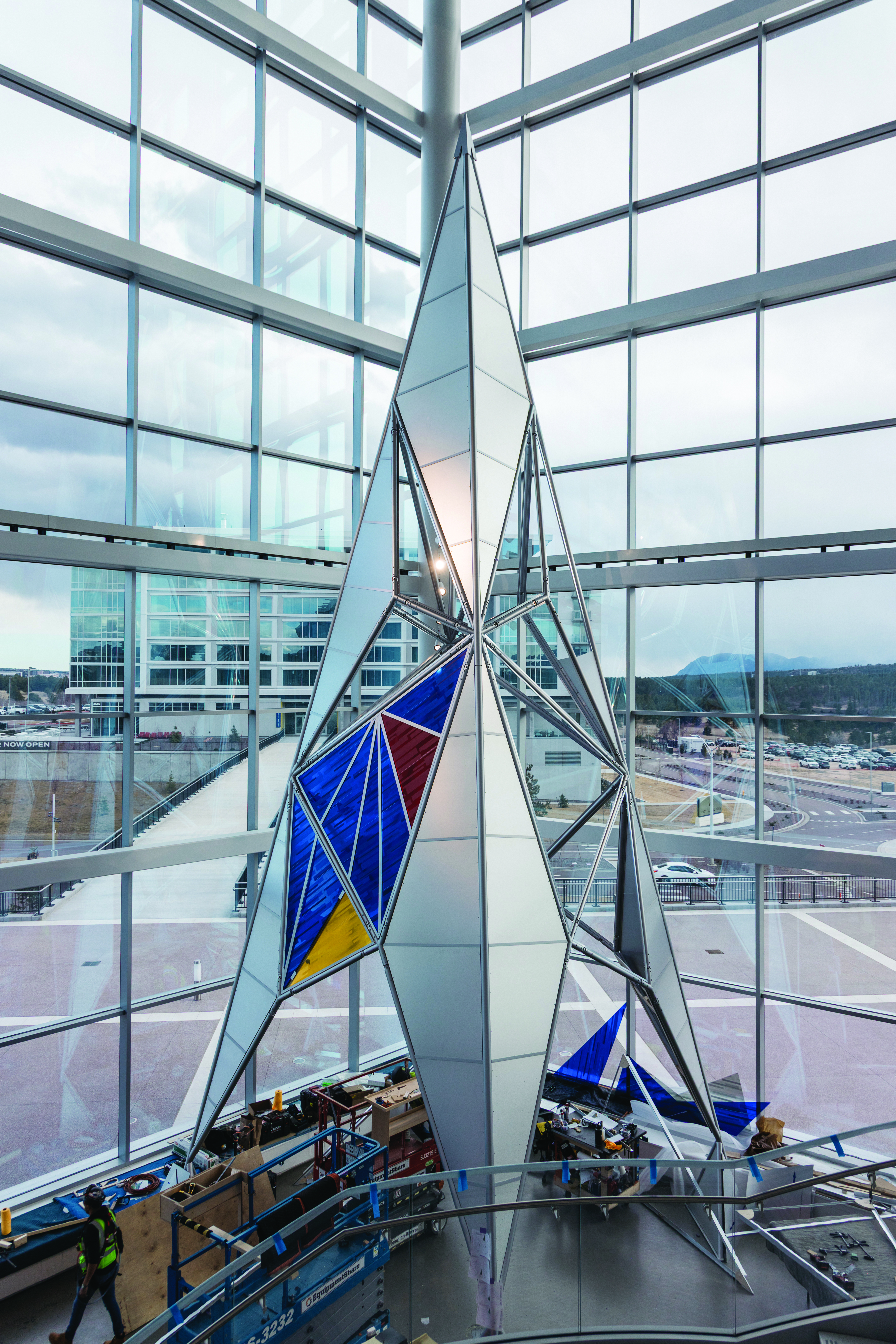
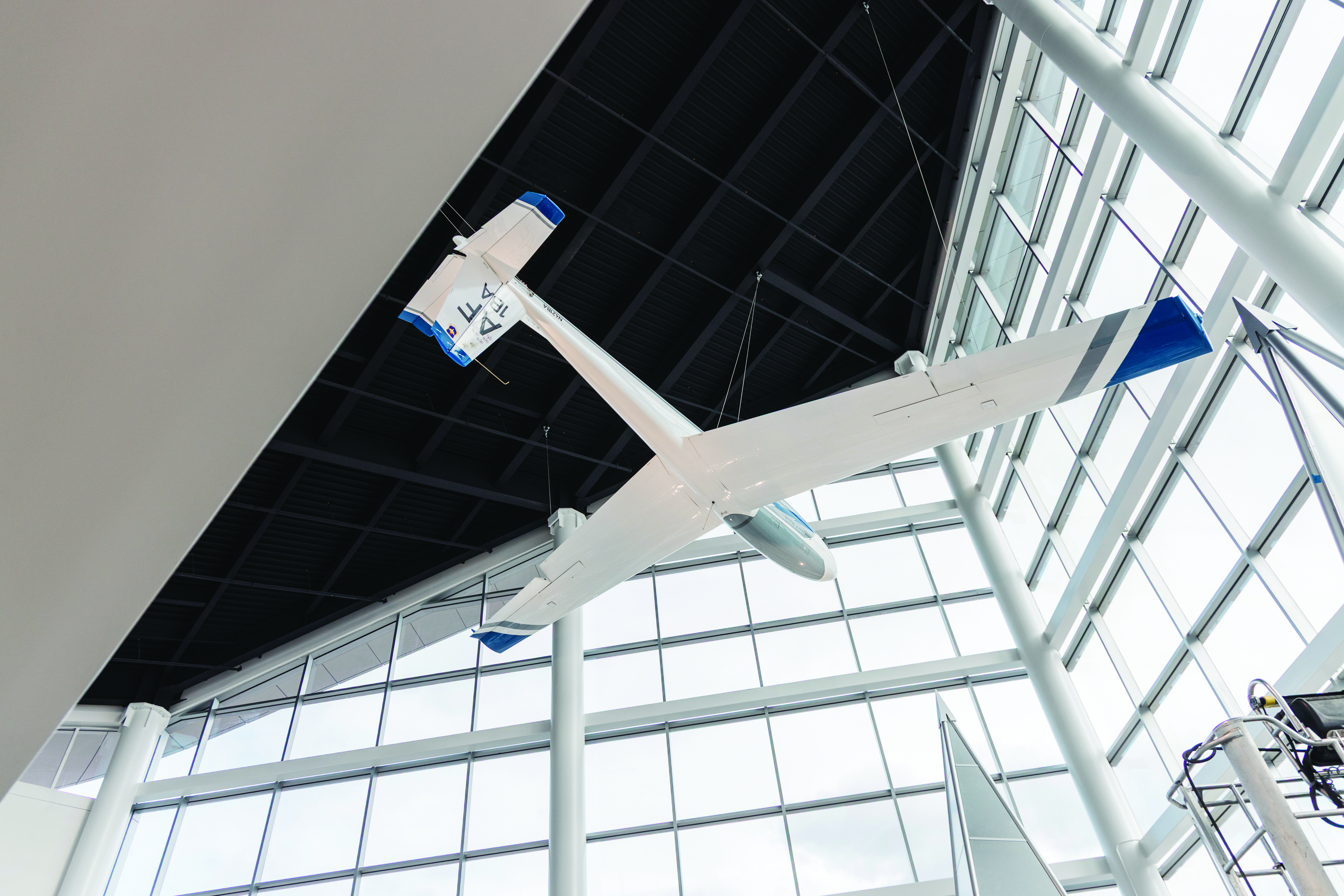
Suspended overhead is a TG-10 glider, inverted in flight and, below it, rise massive tetrahedrons. Neener and Peterson say the geometric forms are inspired by the Cadet Chapel’s iconic spires. Each structure stands between roughly 40 and 50 feet tall and glows with class colors, evoking stained glass.
As visitors move beneath the tetrahedrons, soundscapes of graduation day, commissioning oaths, flyovers and more play throughout the space. By design, there are no large screens here. After galleries filled with motion and interaction, this space invites reflection.
The atrium also draws the eye upward to a spiral staircase leading to the mezzanine.
LOOKING AHEAD

The mezzanine, designated Gallery 6, is designed but not yet fully built out. Additional private support through the U.S. Air Force Academy Association & Foundation will determine how quickly it takes shape, Peterson says. Plans call for a central, enclosed theater seating roughly 40 to 45 people, surrounded by smaller immersive theaters offering 360-degree experiences.
Future visitors may find themselves virtually jumping from aircraft, navigating the Assault Course at Jacks Valley or flying a glider — experiences meant to deepen appreciation for what cadets do every day.
Even before those elements come online, the mezzanine offers striking views of the atrium, the suspended glider and the Front Range beyond. Organizers also envision the space hosting ceremonies and special events as development continues. After descending the stairs, visitors enter Gallery 7, the final chapter of the journey. Here, the focus shifts beyond graduation.
Displays trace the paths available to Academy graduates — as young officers, senior leaders and civilians who continue to serve in industry, education and their communities. An interactive exhibit allows visitors to explore interests and aptitudes, revealing potential career fields that align with their choices.
A closing video ties the experience together, and a prominent QR code links directly to admissions information. The message is clear: If you can imagine yourself here, the next step is yours.
Plans for the gallery, according to Neener and Peterson, include rotating features that highlight notable graduates, and they invite nominations from the Long Blue Line.
PHILANTHROPY AND THE HOSMER VISITOR CENTER
By Steven Lincoln
During the 2022 dedication and cornerstone ceremony for the Hosmer Visitor Center, the Air Force Academy Foundation announced a lead gift to name the new building for Lt. Gen. (Ret.) Brad ’59 and Zita Hosmer.
That $5.5 million gift from Jerry ’70 and Pam Bruni showcased the power of philanthropy to be used in service of and to honor others. Jerry Bruni noted at the time that while other funding sources would finance the construction of the visitor center, the gift from him and Pam would help pay for the interior elements.
“We’ve got an empty shell,” he said. “For it to fulfill its promise, it needs to have engaging displays that will interact with visitors.” The empty shell is being filled with engaging and interactive content that will bring visitors up close to the Air Force Academy’s mission when the Hosmer Visitor Center opens to the public in May.
With the help of a grant from the El Pomar Foundation in Colorado Springs, the Academy installed a TG-10 glider, which is hanging from the ceiling in Gallery 5. The TG-10 glider was used at the Academy from 2002 to 2012 to give cadets firsthand experience flying an aircraft.
Other donors have provided additional funding to help build out the mezzanine level of the visitor center. Accessible by the donor-funded spiral staircase, the mezzanine will offer three immersive theater experiences. The large theater, with a 45-person seating capacity, will screen videos produced by the Academy. Two smaller, immersive theater experiences will offer 360-degree experiences, such as diving off the Academy’s 10-meter board or jumping out of an airplane.
Brig. Gen. (Ret.) Chris Inglis ’76 used a real estate gift to help support the Hosmer Visitor Center. “I love the Hosmer Visitor Center because it presents the Academy to the world. I think that first impressions really matter,” he said.
The Association & Foundation continues to fundraise to bring the mezzanine — Gallery 6 — to life.
MORE THAN A BUILDING
From the start, Academy leaders have described the Hosmer Visitor Center as a recruiting tool. Jerry ’70 and Pam Bruni, whose $5.5 million philanthropic contribution helped make the visitor center possible, says one of the best ways to recruit is to reinforce the message that public service never gets old.
“USAFA exists to support a public purpose,” says Jerry Bruni, who serves with Schnepf and Gen. Hosmer on the Air Force Academy Foundation board. Our main reason for supporting the Hosmer Visitor Center is our hope that visitors, especially young men and women, develop enthusiasm about committing to a life of service.”
But the center isn’t only about those who may spend four years of their young lives at USAFA; it’s also meant to welcome alumni returning for reunions, families visiting for the first time, tourists drawn in by a striking building along Interstate 25 and members of the local community curious about the institution in their backyard.
Its location outside the gate matters. In an era of tighter security, the center restores access and visibility. It also serves as a state welcome center, strengthening ties with state and local tourism partners and positioning the Academy as a gateway to Colorado Springs.
The center’s success will depend, in part, on people, Peterson says. Plans call for a robust docent and volunteer program, drawing on alumni, spouses, retirees and even recently commissioned cadets, putting today’s Academy face-to-face with tomorrow’s applicants.
The Hosmer Visitor Center represents a fresh start: Every gallery began with a blank slate. Designers from Gallagher & Associates — known for projects such as the U.S. Olympic & Paralympic Museum in Colorado Springs and the World War II Museum in New Orleans — immersed themselves in Academy life before sketching a single concept, Neener says. They rode buses with cadets, experienced training environments and listened.
For alumni, the center offers a chance to see the Academy they knew reflected and, for some, transformed. For prospective cadets, it offers a first, powerful glimpse of what lies ahead. For everyone else, it tells a story of commitment, courage and service. And much of it begins, appropriately, with a set of footprints.