
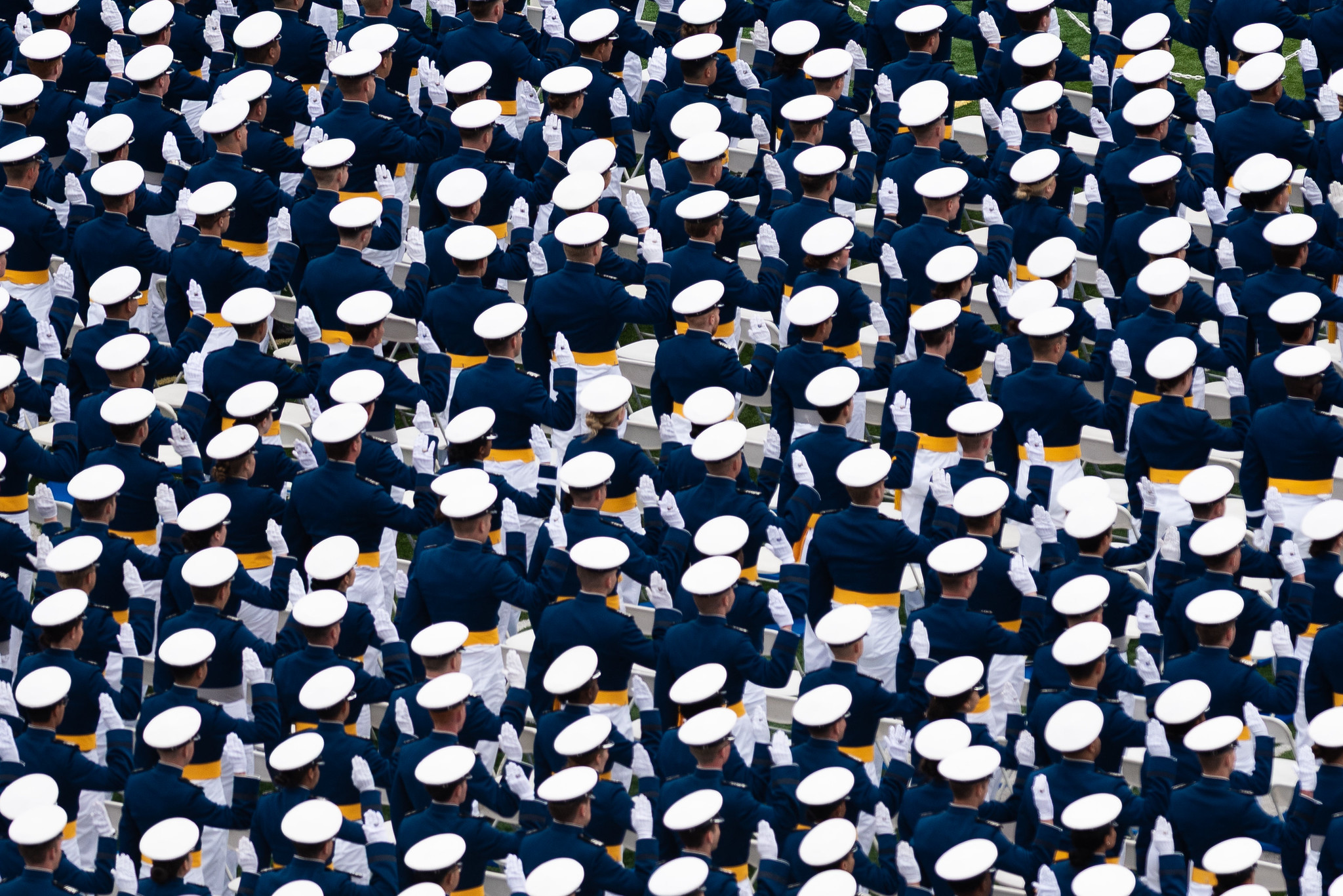
Checkpoints: Built to Serve
The mission didn't end at graduation
The problems followed them home.
Col. Laurel (Huber) Chiaramonte ’03 spent 14 to 18 hours every two weeks handwriting nurse schedules at Nellis Air Force Base, Nevada. Emma Przybyslawski ’10 once needed a sensor system so scarce that only one existed across an entire combat theater. Austin Ollis ’12 examined his Chipotle nutrition data in a two-degree-year biology class and never looked at food the same way again. And three members of the Class of 2024 watched class cabinet initiatives run out of funding every semester for four years and decided, before they ever pinned on lieutenant bars, to create a solution.
Every one of these six U.S. Air Force Academy graduates built a business around solving problems they experienced firsthand.
But USAFA didn’t just prepare them to solve hard problems; it made them incapable of ignoring them.
'My problem and his solution'
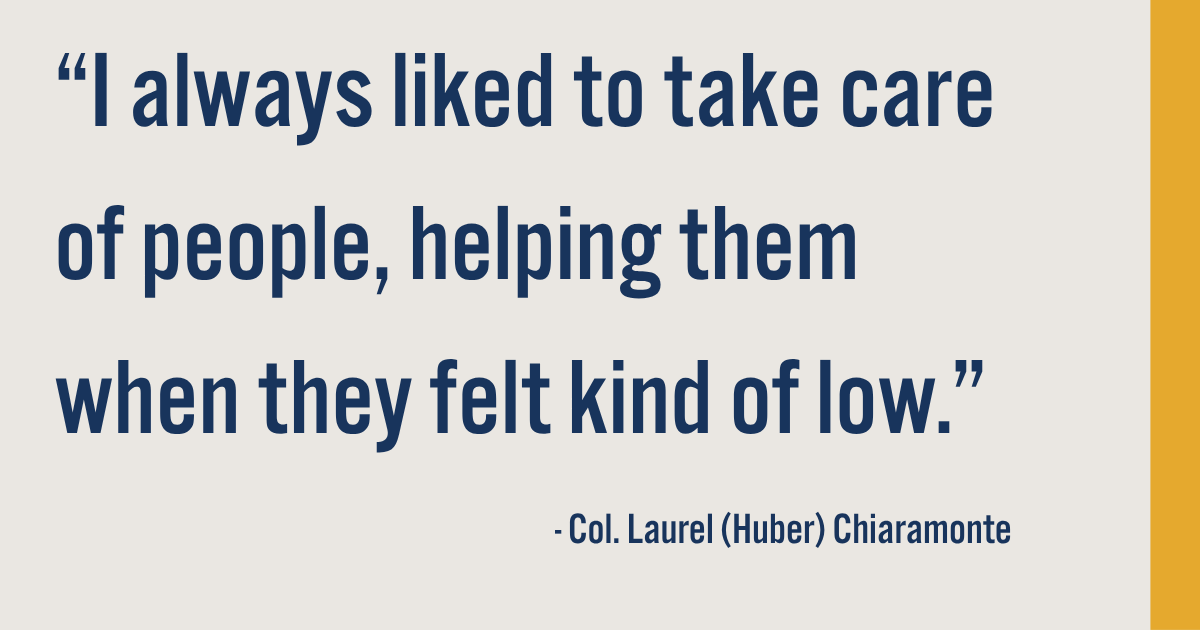
Col. Chiaramonte knew she wanted to be a nurse. “I always liked to take care of people, helping them when they felt kind of low,” she says.
The military was not part of the picture until recruiters came calling about her running cross country at the Academy. She visited USAFA — reassuring her mother that it was nothing — fell in love with the integrity and camaraderie she found there, and changed her mind.
After graduating with a biology degree, Col. Chiaramonte earned her master’s in nursing at Vanderbilt University and went on active duty.
She spent 11 years as an Air Force nurse, including assignments at Nellis AFB, Nevada, Kadena Air Base in Okinawa, Japan, and USAFA, where she eventually led a clinic of roughly 70 doctors, nurses and technicians.
Along the way, she earned an MBA from Colorado State University, motivated partly by health care’s growing business complexity and partly by a problem she was living with every shift: the schedule. Writing a 28-day schedule for 50 nurses consumed her time and kept her off the floor. She turned to her husband for help.
Lt. Col. (Ret.) Michael Chiaramonte ’01, a dual major in operations research and computer science who earned his Ph.D. in industrial engineering from Arizona State University, studied rostering and re-rostering in complex, dynamic environments.
By his calculation, there were roughly 7,000 schedule variables: staff certifications, acuity requirements, charge nurse coverage, license renewals, shift sequencing and the quiet implied bias of a scheduler who subconsciously protected her own days off while everyone else competed for theirs.
He built an algorithm to solve the problem.
“It was my problem and his solution,” she says. They co-founded Duality Systems in 2020, spending the first year building the user interface while navigating a pandemic that prevented them from meeting potential customers face to face.
Where a drone pilot unit spent 140 hours a week building shift schedules by hand, a Duality Systems tool — Balance Scheduler — reduced that to roughly 15 minutes.
The platform has supported health care organizations, Air Force units and Space Force teams, including a commercial satellite tracking operation running three watch floors across multiple continents and time zones.
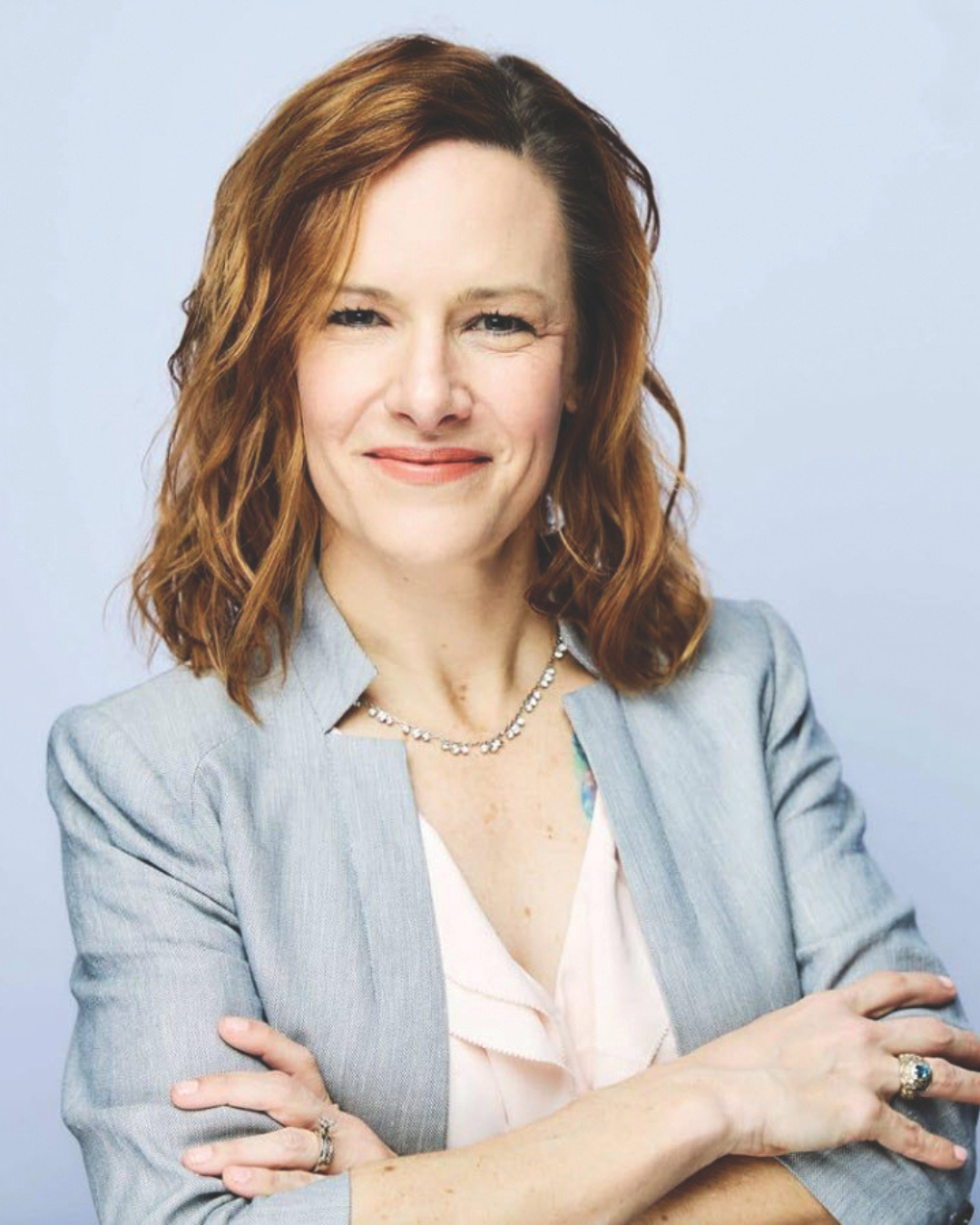
Col. Chiaramonte remains an active reservist. She was promoted to colonel in December 2025 while deployed to Qatar, returning home on Christmas Eve while several colleagues remained there.
“Deploying was hard from a small business perspective,” she says. “Coming back was hard, getting back on the horse and remembering all of the things and bringing those relationships back top of mind.”
Six people make up the Duality Systems team, distributed across four states. Growth means navigating the transition from small business innovation research phase-two contracts to phase three, while also introducing a no-cost version of the platform so potential customers can see it work before committing.
Ask Col. Chiaramonte what surprised her most about entrepreneurship, and the answer arrives with a laugh.
“My favorite thing about being an entrepreneur is having control over my schedule,” she says, “and my least favorite thing about being an entrepreneur is not having control over my schedule.”
From a CEO who built a company around solving labor-intensive scheduling problems, the irony lands hard.
Bronze star to boardrooms

Przybyslawski, a 2023 Young Alumni Excellence Award honoree, left the Air Force Academy after her four-degree year. Ninety days later, she was filing paperwork to come back.
“I felt very much called to go back to the Academy,” she says. “I missed the friendships that I had forged in a really challenging and difficult place. I needed, at that time in my life, the direction and the guidance that the Academy sets every cadet up with. And most of all, I felt like I was abandoning a sense of accomplishment I was working toward.”
She returned as a member of the Class of 2010 and commissioned as a special operations intelligence officer.
In 2015, she earned a Bronze Star in Iraq for her work with the kinetic drone program, collaborating with U.S., Canadian and Australian special operations forces. “From snout to tail, the entire deployment was extremely challenging and grueling,” she says of the tour in Iraq, “and I only survived it because of what I had learned at the Academy — keeping my nose to the grindstone and knowing I could do hard things.”
The builder’s instinct grew from receiving new technology in special operations, where her community served as a forward test bed for emerging capability.
Downrange, she encountered promising sensor systems that existed in such limited quantities that they had to be shared across theaters, leaving operators unable to reliably schedule them in the fast-changing environment of combat. The lesson stayed with Przybyslawski: Accessible capability matters as much as capable technology.
She transitioned out of the Air Force in 2016 and spent years closing the gaps she knew she had.
At Gartner, a global technology research and consulting firm, she learned enterprise sales and achieved the highest performance across all verticals supporting the Air Force and Space Force three years in a row.
Govini, a defense analytics company, deepened her understanding of the market she wanted to serve. Each stop along the way better integrated her thinking and sharpened her instincts.
“Every single stop along the way was like a Candy Land board of learning something new that, when you put it all together, you could run a successful business,” she says. “I don’t think it dawned on me that we could actually do this on our own until probably five or six years after separating.”
She founded Strike Solutions in 2022.
The company builds small-form-factor hardware paired with proprietary software to provide real-time situational awareness to operators at the tactical edge, regardless of domain.
The defense tech company’s products are built to be simple enough for the least technical user, sophisticated enough for the most advanced and priced within reach. On the commercial front, Strike Solutions is developing systems for law enforcement and public safety and security use cases.
Strike Solutions took no venture capital, which meant surviving lean years before contract foundations stabilized. “Lace up the shoes,” Przybyslawski tells every new team member, “because this is very much a marathon.”
Wrong hires drain precious resources in a company with no cash to spare. “If you hire for your blind spots, you can’t lose,” she advises.
For fellow graduates considering the same path, her counsel is direct.
“There will be setbacks. We can’t predict them, but you have to believe it will work out and then make the best decisions you can,” says Przybyslawski, who formerly served on the Association of Graduates board of directors. “Do not think you’re going to skyrocket immediately. You have to be willing to run the marathon, even when one mile feels like five.”
The unofficial company motto captures it more efficiently: “We’re too stupid to quit.”
Motion is the medicine
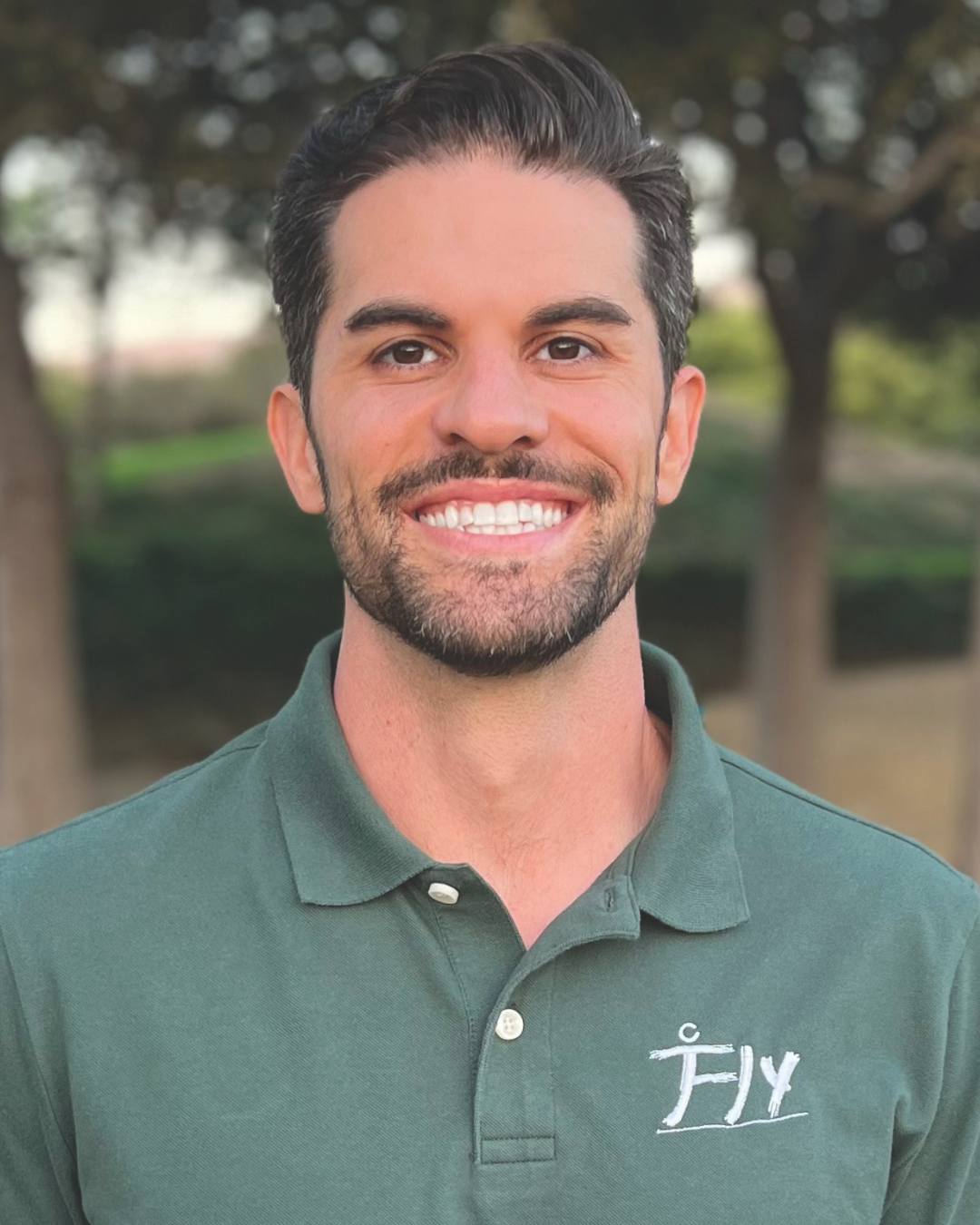
Ollis is a systems engineer by training and a health optimist by conviction. He will tell you those two things are not as different as they sound.
“You can break everything down to a system,” he says. “Even the body. What are the requirements? What’s the integration? What does the testing look like?”
Ollis grew up watching his older brother, a 2008 graduate who played football at USAFA, navigate the Academy’s demands. Then the Academy recruited him to play football for the Falcons as well. Ollis attended the Prep School and arrived at the Academy as ready as he could be for the main course.
He graduated with a degree in systems engineering management and started his Air Force career as a missileer. He then went to work on GPS III satellite programs at Los Angeles Air Force Base, California, managing requirements integration for a nextgeneration navigation spacecraft and eventually leading test verification for $1.5 billion in next-generation receivers across all military branches.
The health obsession ignited his two-degree year at the Academy, when a biology assignment asked him to document his calorie intake for a weekend.
He looked at the cholesterol numbers and started pulling the thread. The best athletes in the world and elite Air Force operators treated nutrition as seriously as training itself. If they were dialing it in to maximize their performance, he decided, so would he.
After the Academy, he got to work optimizing his nutrition and training for activeduty rugby. Along the way, he earned a certified strength and conditioning specialist credential while still in uniform and found himself increasingly qualified in answering people’s health-related questions.
Ollis says Fly Bodies started with his younger brother, who asked for help losing weight. Within a year, his brother lost 75 pounds and returned to Columbus, North Carolina, where people wanted to know what he had done.
Word of mouth became two clients, then 20, then 50.
Educators were the primary customer base.
When Ollis asked if he could run a pilot wellness program for faculty and staff at a school in Palos Verdes, California, the answer was a resounding “yes.” A business model emerged.
Today, Fly Bodies serves private schools and businesses with programs built around minimum effective dose: the smallest intervention with the largest return.
Research from the American Heart Association on step counts and neuroscience around dopamine inform every program design.
Ollis describes a study in which researchers blocked dopamine receptors in rats and then moved their food one body length away. The rats ate food sitting directly in front of them but would not move to reach it. Dopamine, it turns out, drives motivation and movement, not just pleasure.
The practical application lands hard for clients who say they cannot find the motivation to start. “You actually have to almost start the process to begin with to get that motivation,” Ollis explains.
Put on the shoes. Start walking. The motivation follows.
Programs range from a single annual walking challenge to a full suite including high-intensity interval classes, mileage clubs and wellness presentations, along with a companion app that links participants’ fitness trackers so they can see and share their progress.
The technology lets the model scale without requiring Ollis to be present everywhere. For fellow graduates, his advice lands where you might not expect it to.
“The entrepreneurship game is so competitive,” he says. “Being healthy, living a healthier lifestyle, allows you to have a longer runway for resilience. The longer I can stay in this game, the more chances I give myself to really make it bloom.”
'Past, present and future'
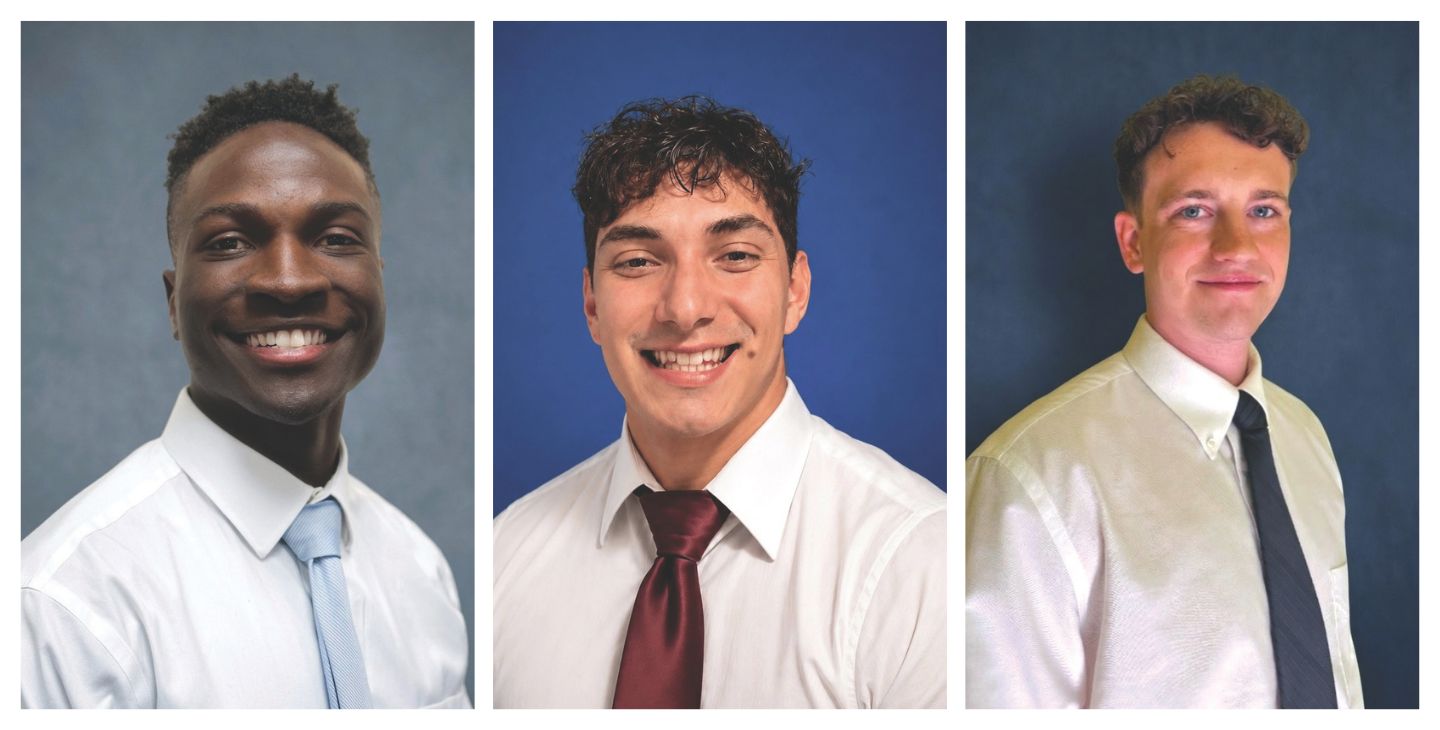
Adedapo “Ade” Adeboyejo, Ryan Treviño and Noah Harper graduated from USAFA in May 2024. By December, they had launched a company to address a problem they had seen grow over their four years at the Academy.
As Class of 2024 president, Adeboyejo struggled to fund class initiatives. Heavy cadet duties left no time to find resources for morale-boosting projects like bringing Chickfil- A to the library, and existing financial avenues were insufficient. By senior year, the gap between ideas and resources was as wide as ever.
Meanwhile, Treviño had written down his goals as a freshman: Join a team, travel abroad and create something at the Academy that would outlive him. He designed the Class of 2024 crest and saw merchandise potential in the symbol as soon as he finished it.
When Adeboyejo brought the funding problem to Treviño and Harper during their firstie year, the pieces connected.
Harper, the class website director, had spent his capstone year building an AI tool through Palantir Technologies that made complex data accessible to non-technical airmen. He saw the same design challenge in commerce: Build a website that harmonizes the unity of the community and uplifts the uniqueness of the individual.
All three were Division I cheerleaders. They had spent four years learning to trust each other under pressure. That foundation became the business.
Wild Blue Merch launched with class-specific merchandise the trio designed in collaboration with each class: apparel, drinkware, home decor and ornaments tied to class crests, mottos and identities.
Twenty percent of the profit from every class-specific product is returned to that class cabinet. Revenue from products not tied to a specific class splits evenly among all four current classes as well as the incoming class. The mission is to bridge the cadet and family experiences, giving parents and supporters a clear avenue to connect with their cadet’s journey.
Running a business while on active duty demands the same time management that carried them through four years of simultaneous academic, military and athletic obligations. They meet every Sunday, and they cover for each other when duty assignments or permanent change of station moves create gaps.
Treviño, a contracting officer at Moody Air Force Base in Valdosta, Georgia, manages social media and brings a view from inside Air Force small business programs.
Adeboyejo, a developmental engineer at Edwards Air Force Base, California, who defended his systems engineering master’s thesis at Colorado State University in January, oversees operations.
Harper, a defensive cyber officer now based at Scott Air Force Base, Illinois, directs the design of both the products and the website.
“We work under the radar,” Treviño says. “We don’t put our faces forward on the merch because we want the mission to be what’s actually behind it.”
The company is expanding beyond the Class of 2024.
Current classes, alumni classes and prominent graduates are all part of the vision. “We are working to give a platform for those identities by collaborating with the classes and not just assuming what their identities are,” Harper says.
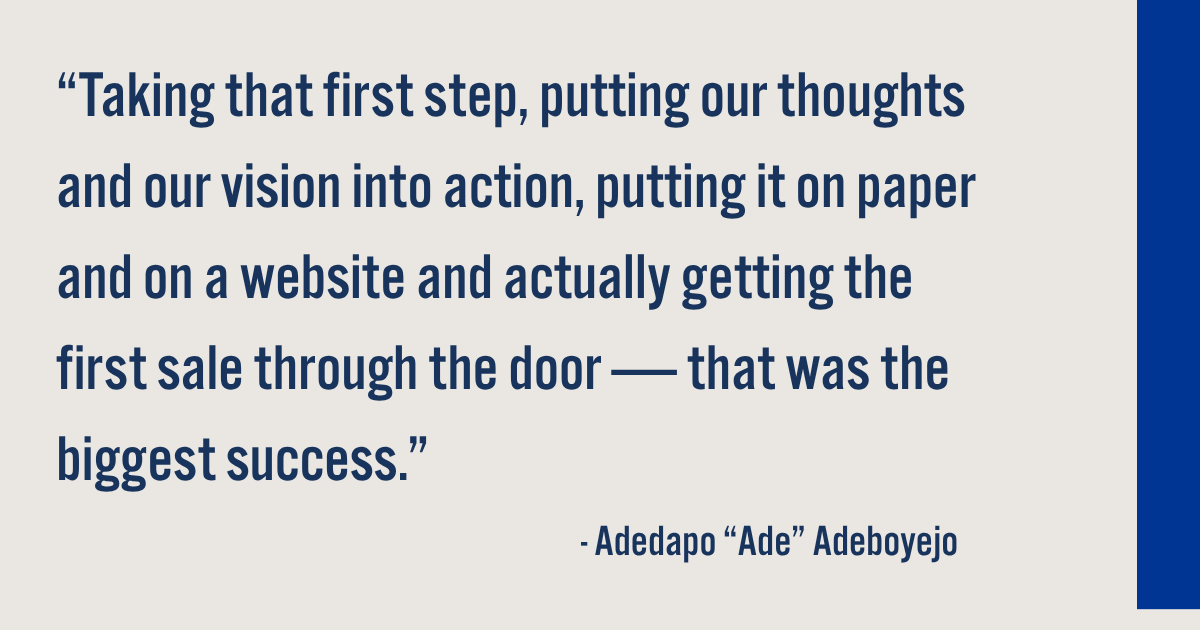
For any graduate considering a similar leap, Adeboyejo passes along counsel he received from fellow graduate Jamie Rhone ’98: There are walkers and there are talkers. “Taking that first step, putting our thoughts and our vision into action, putting it on paper and on a website and actually getting the first sale through the door — that was the biggest success. It’s easier than you think, but the problems get harder the further you go.”
When asked what Wild Blue Merch aspires to be for the full breadth of the graduate community, Noah Harper answers in four words. “Past, present and future.”
The mission continues
In hospital corridors and defense labs, on school campuses and in barracks after duty hours, these six graduates are building with the tools the Academy gave them: the ability to identify what breaks, the confidence that they are the right people to fix it, and the discipline to keep going when the timeline extends beyond the plan.
Przybyslawski frames it in the terms that defined her career in special operations.
“I wake up every single day knowing that we have to bring our A game,” she says, “because people are on the line.”
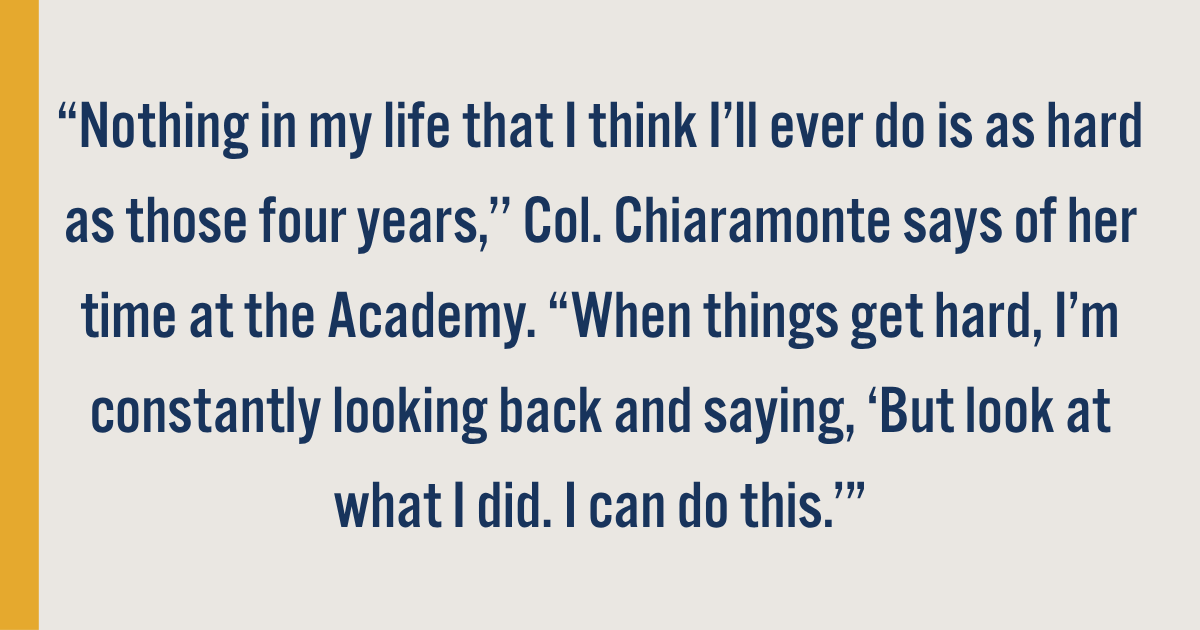
Chiaramonte measures it against the hardest four years of her life and keeps building.
Ollis designs programs for communities that are already carrying too much.
Three officers who cheered on the sideline are now reinvesting the Academy’s spirit into the classes that follow them.
Their businesses look nothing alike. The missions underneath them mirror what they learned at USAFA: Lead with character, serve with purpose and do not stop when times get tough.