
Checkpoints: A New Day
First female USAFA cadets begin 47-month journey
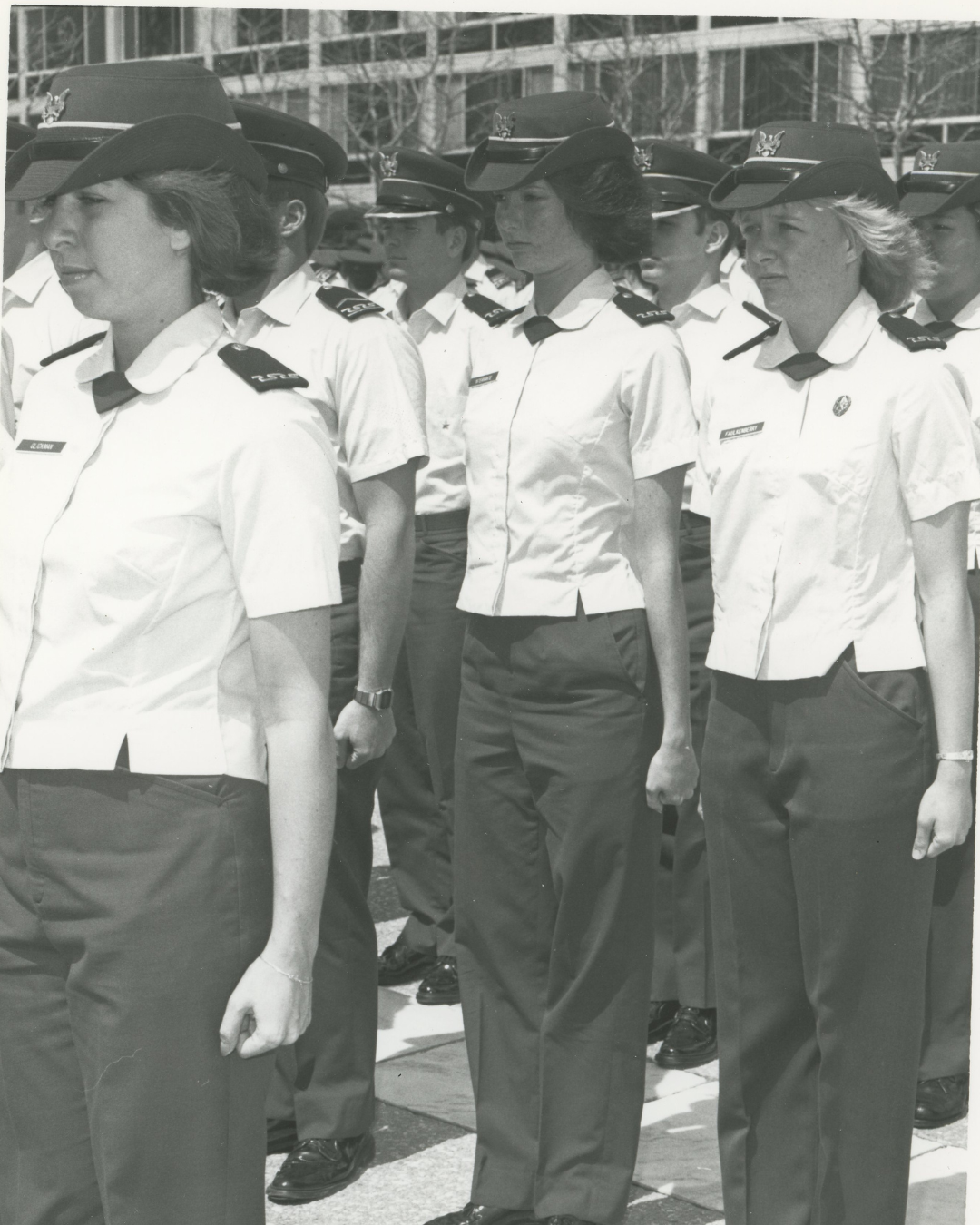
The years of preparation and months of intense activity led to one momentous day — June 28, 1976, when 157 female cadets took their place at the base of the battle ramp alongside their 1,436 male classmates as members of the U. S. Air Force Academy Class of 1980. What followed was the most unique and closely observed year since the Academy opened its doors at Denver’s Lowry Air Force Base in 1955 to greet the Class of 1959.
DAY 1
George Fagan, in his book The Air Force Academy: An Illustrated History, reports that “The first member of the Class of 1980 was Joan Olsen, who had gotten up at the crack of dawn and was sitting on her suitcase at the base of the ‘Bring Me Men’ ramp ... when the first inprocessing officials arrived.”
Academy officials did their best to ensure that inprocessing day took place as it always had and with a minimum of alterations.
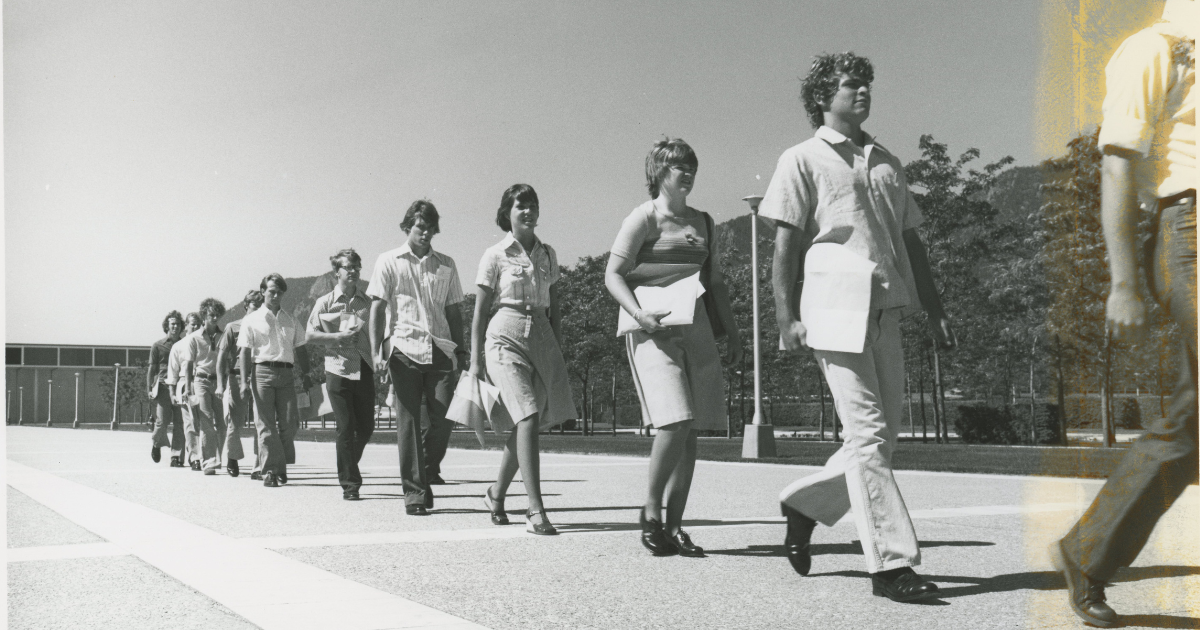
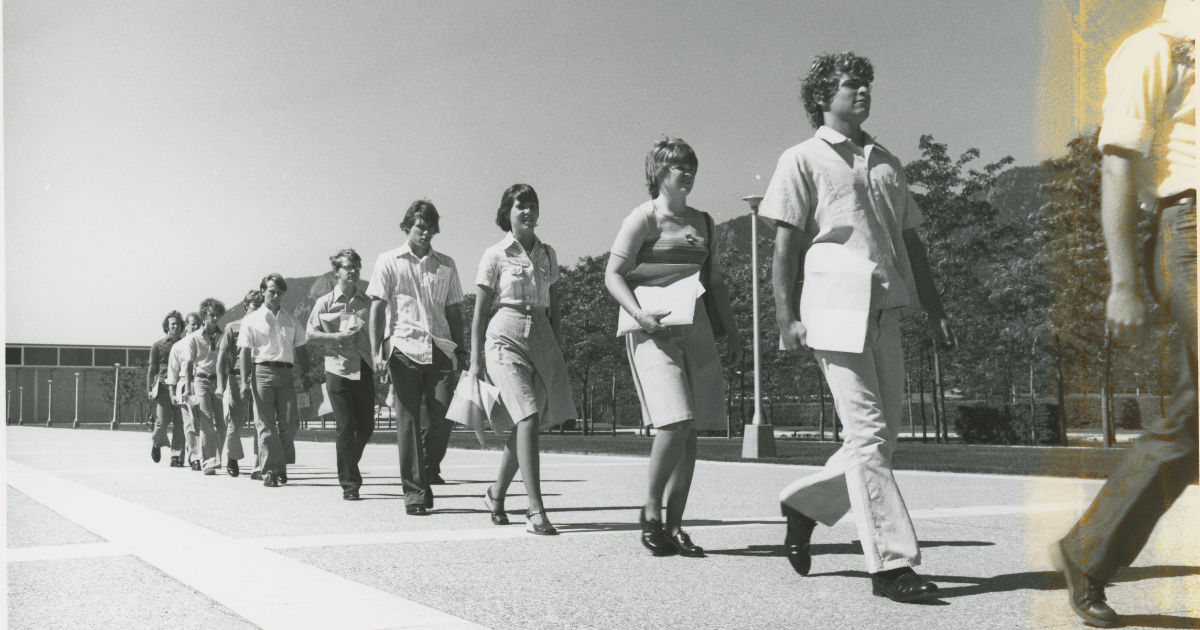
For the most part, they succeeded. Appointees of both sexes did the same things other incoming appointees had done before and thousands more would do after — paperwork, immunizations, uniform issue, haircuts, a first meal in Mitchell Hall, rudimentary marching about the Terrazzo and ultimately to their Vandenberg Hall dorm rooms, and the evening swearingin ceremony that changed their status to basic cadets.
But, of course, it was different. While media outlets always show some interest in the arrival of a new class, the coverage this time was broader and more national, much like in 1955.
Fagan writes, “The historic day was recorded for history by forty-seven media representatives from all the major TV networks, national and international news services, and the national magazines.”
That interest was a continuation of the intense press coverage that had begun even before President Gerald Ford’s Oct. 7, 1975, signing of Public Law 94-106, known as the Department of Defense Appropriation Authorization Act, opening the academies to women.
One of those media representatives asked Julie Richards if she minded them taking a photo of her. It turned out to be perhaps the most iconic photo ever taken of the battle ramp and the three words — BRING ME MEN — that graced the space above the ramp from 1964 until 2003. The photo depicted Richards carrying a suitcase and looking over her shoulder as she approached the ramp.
As they arrived at the Academy, the women of the Class of 1980 mirrored the men in the Class of 1959 in many ways. For example, some of the incoming appointees were older and had a year or two of college behind them. Additionally, as Fagan writes, “A number of the women cadets were military dependents whose fathers were on active duty or retired. Eight women had been graduates of the Academy Prep School. Others had been enlisted members of the Air Force or had been members of ROTC units in colleges and universities.”
The arriving female appointees found few women in the Academy classroom or the gym, though the Air Force had begun to assign more women to the staff. Among them were the 15 air training officers who were female lieutenants serving as surrogate upperclassmen — another parallel between 1976 and 1955, when members of the Class of 1959 had male ATOs to guide them.
BASIC CADET TRAINING
Basic Cadet Training in 1976 had a slightly different focus, but not because of the enactment of Public Law 94-106. Rather, it was due to the superintendent. Lt. Gen. James Allen, who had assumed the position in August 1974, favored a more positive approach to training.
“Following Basic Cadet Training 1975,” Brig. Gen. (Ret.) Phil Caine, a colonel and senior Academy official at the time, explained, “the Superintendent and Commandant of Cadets [Brig. Gen. Stanley Beck] determined that changes were needed. A prime objective was to make the training as motivational and personally challenging as possible, with an emphasis on positive reinforcement and feedback. In announcing the changes, the Superintendent stressed that they were not instituted because of the entry of women in the Class of 1980.”
Despite those assertions, however, there were some skeptics. Marianne Owens LaRivee ’80 contends, “Most cadets assumed the changes were simply for the women, complaining that Academy officials had abandoned their claims to make no major changes.”
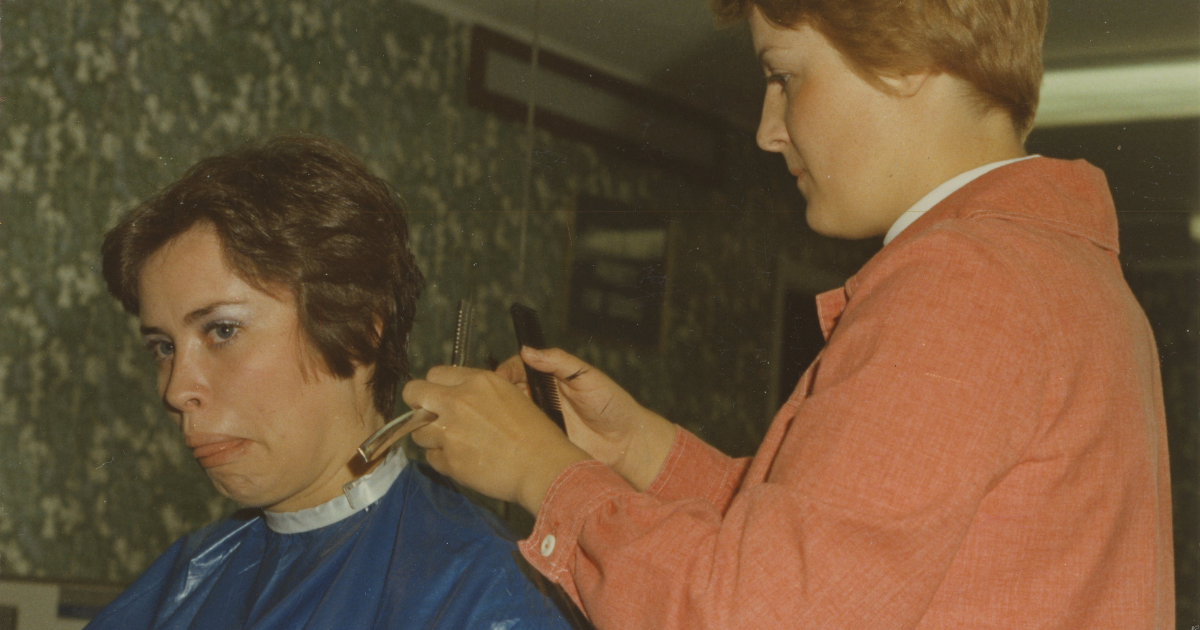
One other new wrinkle: While the incoming men all got their heads shaved, the women were left with a few inches of hair. Ostensibly, they were given the choice of four styles but, as Kathleen Utley Kornahrens ’80 observed, “I looked around at the women and could not distinguish between any of the four choices. It seemed it didn’t matter which style we chose. The end results looked all the same: cropped and choppy.”
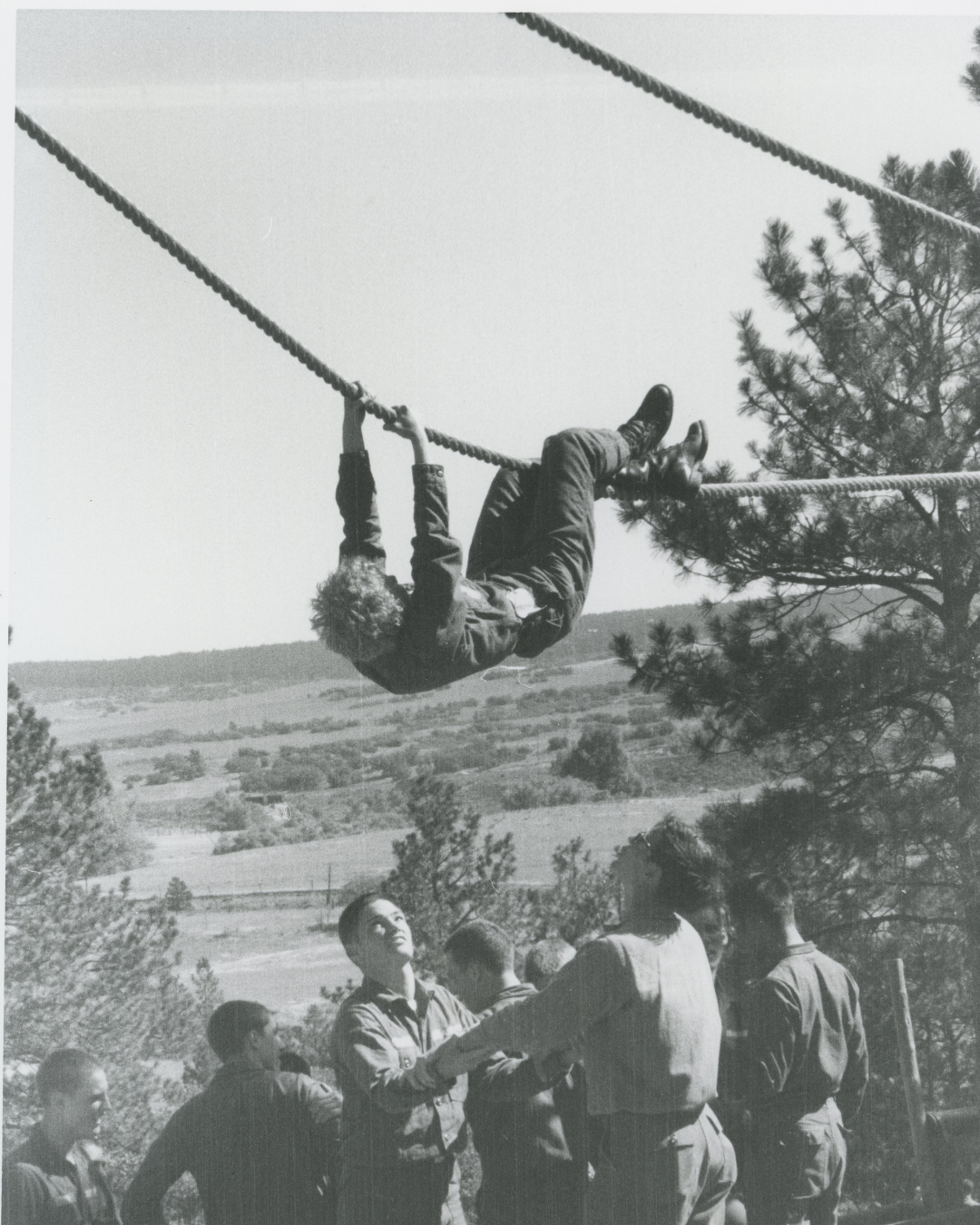
While Academy officials made every effort to keep training the same for men and women, some modifications were necessary. In her article The Integration of Women Into the United States Air Force Academy, Alison Gawlinski ’07 describes one such instance: The confidence course in Jacks Valley changed because “. . . the obstacles would be too high for women to accomplish the tasks successfully.”
THE LIVING SITUATION
When the Class of 1980 arrived, all female cadets were housed on the sixth floor at the east end of Vandenberg Hall. Although assigned to all Basic Cadet Training squadrons and, after BCT, to cadet squadrons 1-20, they did not live in those squadron areas among their male squadronmates.
The arrangement was problematic from the beginning. The women trained, marched and executed their required tasks with their assigned squadrons, which required them to travel back and forth between their residences and those of their squadrons. The extra time on the Terrazzo and in the hallways while in transit exposed the females to additional (albeit “positive”) training.
Living in the isolated area resulted in other training differences as well, as the women missed many of the activities that took place in the main (men’s) squadron areas.
Some squadrons attempted to address this issue. LaRivee recalls, “Wing, group, and squadron cadre in our chain of command were allowed to be in the women’s area almost any time and usually came between dinner and academic call to quarters to ensure that we were receiving a similar training experience to our male classmates.” This, however, varied by squadron, with the ones located at the opposite end of the quarter-mile-long Vandenberg Hall visiting less frequently.
The geographic separation between the female cadets’ housing and their assigned squadrons also hindered relationship building. Bonding opportunities that arise organically while living in close quarters were limited. This was even more of a problem in the third and fourth group squadrons that did not have women assigned to them during that semester.
Furthermore, this isolation of the women led to misperceptions. Some male cadets imagined the women’s area as nicer and posher.
Gawlinski addresses this issue, writing, “According to Cadet Karen Wilhelm [’80], segregating the female cadets encouraged rumors. Several male cadets believed that the women’s separate housing area included not only showers, but also bathtubs and feather beds.”
The reality was far different. Dr. Ginny Caine Tonneson ’80 points out how rudimentary the modifications in Vandenberg Hall were, observing, “The latrine was converted to a women’s restroom simply by putting a large grey plywood box over all the urinals.”
The bottom line was that the separated living arrangement wasn’t good for anyone.
To their great credit, Academy officials recognized this problem and did something about it. During an intense pre-admission study, there was discussion of the possibility that billeting the females separately could cause problems with their integration, so it wasn’t a total surprise.
In fact, Kornahrens, writes, “Superintendent [Lt. Gen. A.P.] Clark, the superintendent who oversaw most of the planning for our integration but left before we actually arrived, admitted, ‘One of the most significant mistakes was putting the women in separate barracks. It isolated them from their squadronmates. So many things go on in a barracks that you need to participate in to become bonded with the rest of the squadron, so you don’t feel like outsiders.’”
While the Cadet Wing was home for the holiday break, staff made changes to the Cadet Area to accommodate the dispersal of the female cadets throughout the wing, including the movement of some of the women across the Terrazzo to Sijan Hall, albeit in a female-only section. (Starting the following summer, female cadets would be housed within each cadet squadron.)
When cadets returned to Colorado in January 1977, the females had been administratively assigned to all 40 squadrons. For many of the women, the shuffle meant more change — adjusting to new upperclassmen, new squadron classmates, new squadron cultures and, for some, a move across the Terrazzo.
Still, the change was universally considered a good one. As Kornahrens comments, “It really was so crucial for our assimilation and a huge plus that the administration pivoted and moved us halfway through, difficult as it was. All squadrons witnessed firsthand women as Doolies, our successes and failures.”
ON THE FIELD
While the military and academic programs underwent few changes, the athletic program saw some alterations. Extensive efforts went into modifying the Academy’s offerings, to include physical education classes, the physical fitness test and intramurals.
Perhaps most visibly, Academy officials built an intercollegiate athletic program from scratch.
Remarkably, during that first year, the Academy fielded intercollegiate teams in every sport that the Academy currently supports — all with no additional staff and no additional appropriated funding.
Both recruited and walk-on cadet-athletes made up the intercollegiate teams. The NCAA had yet to begin overseeing female athletics, so women’s collegiate sports were sanctioned by the Association for Intercollegiate Athletics for Women.
Despite being composed of members of only one class, the teams represented USAFA admirably. Swimming set a high standard from the beginning. On March 10, 1977, cadets Bonnie Schaefer, Julie Richards, Karen O’Hare and Ginny Caine earned All-America honors in swimming.
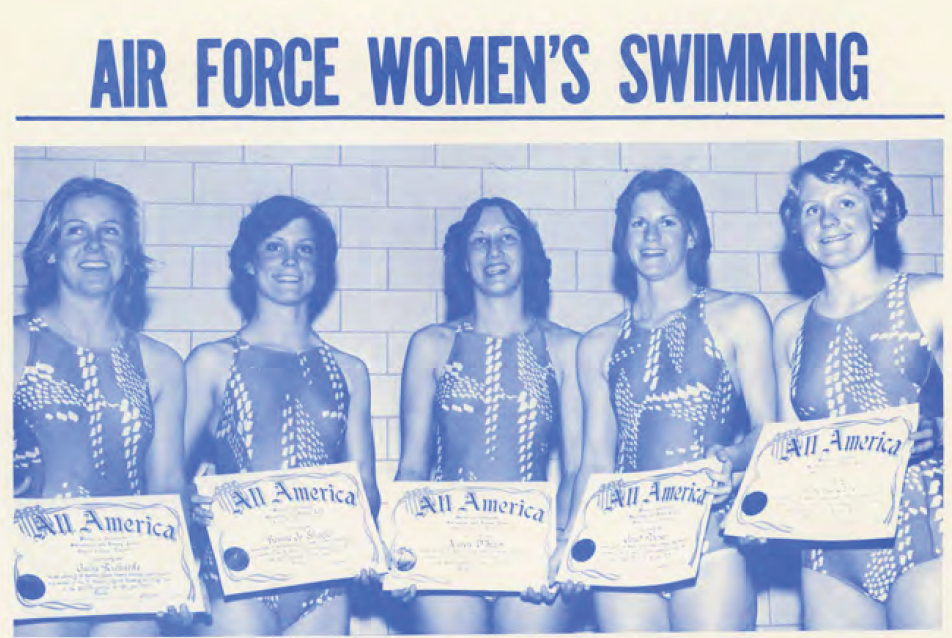
Even with this status, as members of a first-year team, the previously mentioned swimmers were awarded junior varsity letters. Their coach, Lt. Col. Paul Arata, lobbied for them, and the following year, they received two-year varsity letters to acknowledge their earning varsity status the first year. T
he program’s strong start — as well as the many other changes to the athletic programs — were largely attributable to the leadership of two individuals: Col. John Clune had been the Academy’s director of athletics since November 1975. Prior to that, he had served at the Academy as an air officer commanding and assisted with the men’s junior varsity basketball team (he had been an All-American basketball player at the Naval Academy).
Capt. Micki King arrived in 1975. A national celebrity, she had won the Olympic gold medal in 3-meter springboard diving at the 1972 Munich Games, four years after she hit the diving board and broke her arm on her next-to-last dive at the 1968 Games in Mexico City.
As with other elements of the USAFA experience, physiology would play a major role in many of the athletic adaptations. On the physical fitness test, for example, women would do a flexed arm hang rather than pullups, and modified pushups.
In his history of Academy athletics, Don Barrett writes: “After many months of study and experimentation, several changes were made in the physical education instructional program. Boxing was replaced with fencing for women, wrestling with body development (upper body strength) [weightlifting], and handball with racquetball. In intramurals, women generally would not participate in contact sports such as football and lacrosse.”
Cadets of both sexes would participate in the same athletic programs whenever possible. Gawlinski reports that planning determined that, “Women would take some of the same classes as men, such as swimming, physical fitness, judo, survival swimming, unarmed combat and self-defense.”
Gawlinski also writes about Project Blue Eyes, a seven-phase program that Academy officials instituted to guide the integration of women into Academy athletics. It was a long-term plan, intended to last until 1985.
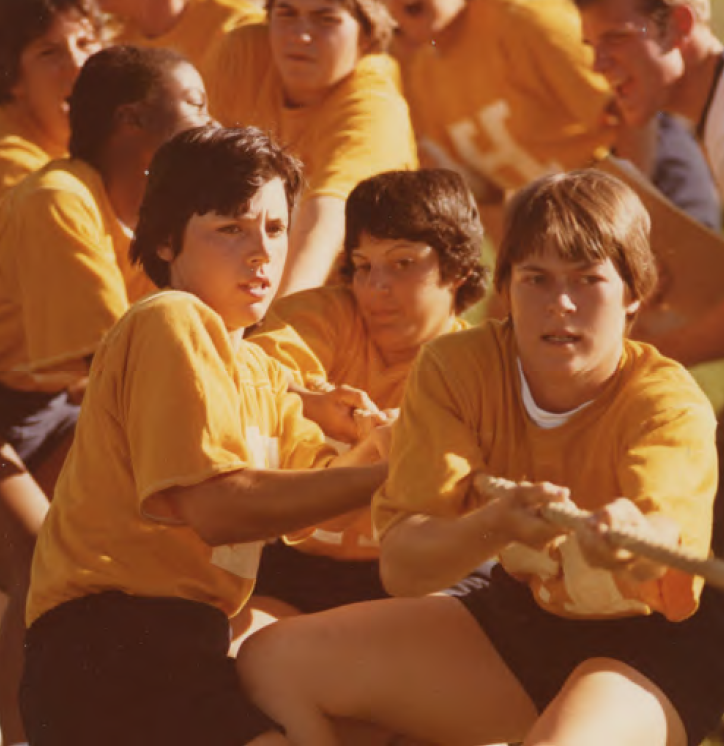
The first phase was the training of the ATOs, undertaken with an eye to help determine what changes were required for the new female cadets. The ATOs’ performance informed some of the alterations made to the Class of 1980’s training.
The second phase was physical education education during BCT and the first year. That included helping the cadets adjust to the altitude and conditioning them for the rigors of USAFA life.
During other phases over the years, Gawlinski reports, officials evaluated the cadets’ results and adjusted the athletic programs — physical education classes, the PFT and intramurals — accordingly. For example, on the PFT, the flexed arm hang was changed back to pullups, and regular pushups replaced the modified ones.
“The reason for these alterations,” Gawlinski writes, “was that the women’s performance evaluated in Project Blue Eyes far exceeded the expectations for them on the physical fitness tests.”
Lt. Col. (Ret.) Dave Schichtle served as head coach of the Academy’s first intercollegiate women’s basketball team. He has fond memories.
“If I could sum up my overall experience with cadet women athletes,” he says, “it would be how tremendously motivated and goal-oriented they were.
“As an athlete and former officer,” he continues, “if I had their determination to succeed, I could only imagine how much more I could have accomplished in my life.”
A MIXED RECEPTION
The female cadets-to-be arrived at the Academy with varied expectations.
“Some of us had been warned by fathers who were grads or brothers who were cadets that not everyone would be thrilled with the idea of women cadets,” Wilhelm remembers. “Others were a bit more naïve when it came to potential negative attitudes. It never occurred to me, for example, that there would be people who thought I shouldn’t be there.”
LaRivee had an early indication of resistance.
“During an orientation meeting for cadet candidates at Andrews AFB,” she relates, “USAFA upperclassmen told me that women would face strong opposition once they arrived and would probably quit after realizing that they were neither welcome nor suited for the rigors of the Academy.”
Fagan sets the stage: “… The women of the Class of 1980 were forced to contend with some serious problems over which they had little or no control. Among these problems were being the object of constant publicity, resentment of male peers, and bucking male traditions built up over the years.”
In many respects, the women regarded those problems as just another challenge. They were additional obstacles on their paths.
“We knew we were part of a larger goal,” LaRivee says, “and in many ways our experience was representative of women breaking into other traditionally male-dominated spheres: business, politics, academia.”
She says, “From our perspective, we had an opportunity previously reserved for men and we couldn’t squander it. We wanted to survive the rigors of Academy life on the same terms as our male classmates. The stakes were high: We were proving to Congress and the nation that women belonged at the Academy, that we could not only survive but excel.”
As it turns out, the reception seemed to lean to the overall positive. Much of the credit for this was attributed to Gen. Allen’s attitude. Whether acceptance was the actual opinion of the male cadets or the result of their professionalism and willingness to accept the situation could be debated.
That is not to say the transition was without instances of inappropriate comments and behavior. To discount that aspect of the first year would paint an inaccurate picture.
Perhaps acceptance could be viewed as a bell-shaped curve, with extremes on each end. Outwardly, at least, most of the men at the Academy just got on with it.
Recalling those intense days, Tonneson writes, “The females received so much attention when we first arrived that I was afraid our male counterparts would somehow hold it against us. I found that wasn’t the case at all. They were curious more than anything. They wanted to know what it was like in the women’s area and what the ATOs did.”
She goes on to say that her male classmates “are the real unsung heroes of the Class of 1980. They received barely any publicity although they were most certainly impacted by the arrival of females. They helped break the barriers alongside us.”
Kornahrens reserves the highest praise for those male classmates undergoing training with her.
“They never knew a single-gender academy,” she says. “They started with us, marched with us, and saw both the trials and the perceived advantages we had in that first year.”
“Our male classmates accepted us even with the added burden,” Kornahrens says. “They accepted us on squadron intramural teams — many were coed, but unequal physiology meant disparate abilities, but still we were teammates. They were only photographed when they stood near one of us. They were singled out for some harassment by upperclassmen for having women in their class. Overall, they were brothers and classmates and friends and supporters. I truly believe that their support and acceptance were essential to the success of our class.”
SUMMER 1977
The first year wrapped up like all others at USAFA: an intense culminating event for the fourth-class cadets followed by their recognition as upperclassmen, the graduation of the firstie class, the subsequent “promotion” of the three lower classes and the shifting of focus to summer programs.
For the Academy and the Class of ’80, it was the conclusion of a hectic year of historic importance. For the women of 1980, it was a successful demonstration of their grit, resiliency and talents.
Gen. (Ret.) James McCarthy, who served as vice commandant of cadets during the transition, succinctly summarizes the situation: “The women that came in were superstars and did very, very well.”
George Fagan concludes, “They were able to cope successfully with just about every obstacle. The women were able to prove that they could hold their own in every sphere of the Academy activities.”
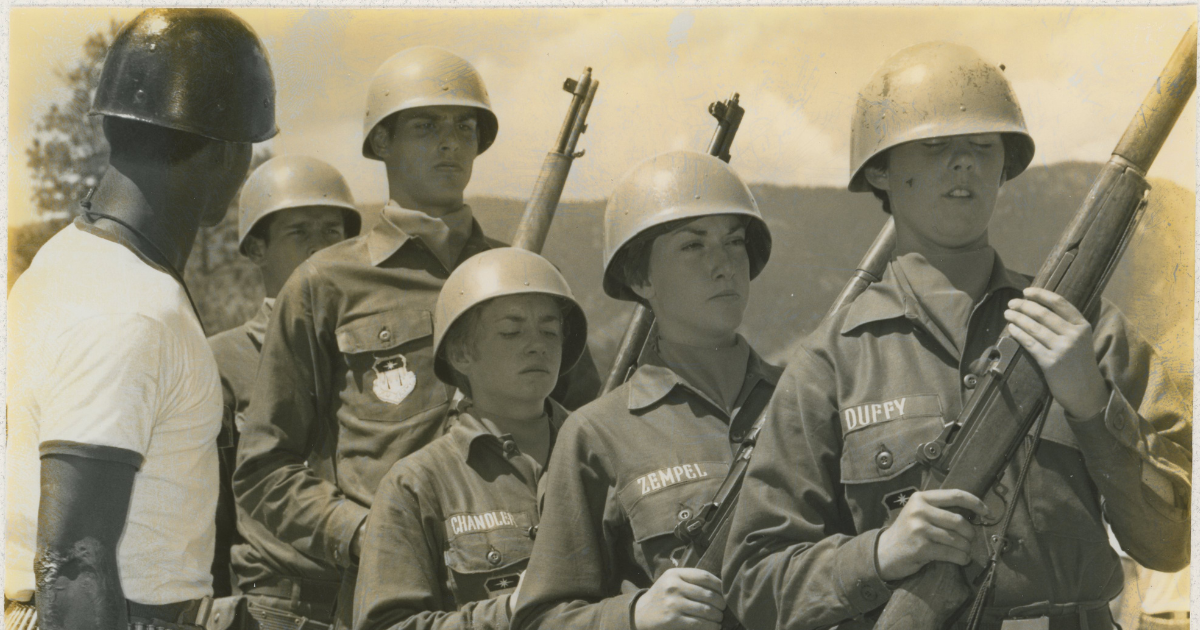
The numbers showed all of that to be accurate, validating Gen. Allen’s predictions that women would attrit at a rate lower than the average attrition rate for men, and that the presence of women would have the knock-on effect of lowering the men’s rate as well.
“The top officials in the Pentagon were pleased with the attrition statistics for the first year of coeducation,” Fagan writes.
On Sept. 11, 1977, The New York Times Magazine published an article by Grace Lichtenstein, A Year Later: How Women Are Faring at the Air Force Academy.
In it, Lichtenstein writes, “The women of the Class of 1980 are sure of one thing. Their experience will make life easier for the women who come after them. Meanwhile, they’ll go to considerable lengths to show that ‘anything you can do, I can do too.’”
And with that, the stage was set for the arrival of the Class of 1981 and the further integration of the Cadet Wing.
Editor’s notes: The quotes from Brig. Gen. (Ret.) Philip Caine and Dr. Ginny Caine Tonneson are taken from Dr. Tonneson’s book, Joining the Long Blue Line: The First Women at the Air Force Academy. Similarly, some of Kathleen Utley Kornahrens’ quotes come from her book, Bring Me Men … Brought Women: Marching with the First Female Cadets at the U.S. Air Force Academy.
BONUS CONTENT: THE AIR TRAINING OFFICERS
In 1976, 15 carefully selected female junior officers reported to the U.S. Air Force Academy to serve as air training officers, surrogate upperclassmen for the soon-to-arrive female cadets. The Academy had successfully utilized the same procedure with male cadets in 1955 when the Academy opened.
Then-1st Lt. Terry Gabreski was one of those officers. She would conclude her active-duty Air Force career in 2010 as a three-star general serving as vice commander, Air Force Materiel Command, Wright-Patterson Air Force Base, Ohio.
Lt. Gen. (Ret.) Gabreski provides some insights into the ATO program.
What motivated you to become an ATO?
I wanted to be an ATO after I found out about the program. I had been trying to get an assignment to USAFA, but the personnel folks said I had to be a captain and have a Ph.D. I was interested in USAFA since I lived there in the mid-’60s when my dad, Alonzo Walter, was an AOC and group AOC. I felt like I could make contribution.
Describe the training you underwent before the arrival of the female basics.
Our ATO training from January to May 1976 was conducted by cadets. We were allowed to wear our rank, but in every other way we were treated like basics — we lived in Vandenburg Hall, called minutes, marched to Mitch’s, did shower formations, memorized Contrails, and, in my case, had a special inspection. We also did In-ranks inspections; Survival, Evasion, Resistance, Escape; Saturday morning inspections, Jacks Valley — everything basics would do. USAFA used our experiences to prepare for the arrival of Class of ’80, as well as to prepare the Cadet Wing for seeing women perform previously all-male training.
Did the ATOs have a role in planning before the arrival of the female cadets?
ATOs were not part of planning for female cadets, other than our training, which gave some good feedback on what might need to change.
What was the ATOs’ day-to-day role during BCT and the academic year?
During BCT we were assigned to basic squadrons (I was with Bearcats), and during the year we were assigned to cadet squadrons. We were to serve as surrogate upperclassmen and role models. We advised the cadets training the women, and the women were able to see that other women had completed the same training. The men had never trained women, so we answered their questions, like "What do you do when a woman cries?” We answered, “What do you do when a man cries?” The answer was always, “Make them stop,” so we told them that was the same answer for the women.
Did the ATOs have a role in the decision to disperse the female cadets from their isolated housing?
We gave feedback on dispersing the women to their squadrons. It was clear to us that by keeping the women separate, the Cadet Wing thought they were being given special treatment. This was a good move.
How long were the ATOs at the Academy?
After the first year, the official ATO program was not continued since the members of the Class of ’80 were now upperclassmen. Some ATOs remained for a while.
As you look back after 50 years, what are your thoughts?
Reflecting on that time, I’m proud USAFA chose to employ this program. No other academy did this, and we had the highest retention rate of women. For me personally, I got to do all kinds of things I never would have had the opportunity to do otherwise (earned Airmanship 490 jump wings, soaring, etc.).