
50 years of service
USAFA makes the final preparations for the arrival of female cadets
U.S. Air Force Academy officials had been preparing for years to seamlessly admit female cadets when the school eventually became coeducational. That time arrived on Oct. 7, 1975, when President Gerald Ford signed the bill opening the nation’s service academies to women.
The theoretical became real, and USAFA was ready.
The next day, in fact, the Academy’s director of information rolled out a detailed press release.
Lt. Gen. James Allen, Academy superintendent, set the tone on base. In his Nov. 24, 1975, letter to the faculty and staff, he wrote, “Overall, our program for producing women Air Force Academy graduates will be exciting and challenging. … I am confident that, with positive support of all assigned personnel, the Air Force Academy will continue to produce outstanding Air Force officers, both men and women, and that we will meet successfully the new challenge of becoming the finest coeducational institution in the nation.”
Gen. Allen would receive praise for his leadership during the initial admission of female cadets.
There was still much to be done. The admissions office quickly pivoted, while Academy officials heightened their focus on logistics and programs. At the same time, young women throughout the country, like their male counterparts, were completing their Academy applications and evaluating whether they actually wanted to become cadets.
Finding Cadet Candidates
Of all the tasks that had to be accomplished before the Class of 1980 could report to the Academy the following June, the most urgent was beginning the time-consuming process of contacting, attracting and evaluating qualified and motivated candidates to fill the female component of the class.
The first statement in the Oct. 8 press release announced that the Academy would admit “[a]bout 100 to 150 women cadets.” That prediction was close, as 157 female appointees would show up on Inprocessing Day.
With that charge, the Admissions Office and its network of admissions liaison officers got even more busy than usual. They consulted with the U.S. Air Force Recruiting Service to develop programs specifically tailored to women.
There were only six women among the 1,500 liaison officers, but officials pledged to increase that representation in the LO force.
In his book The Air Force Academy: An Illustrated History, George Fagan wrote, “In addition to encouraging press and TV coverage, the Academy Admissions Office sent letters to every high school principal in the United States enclosing copies of the Academy’s 1976 catalog and copies of A Guide for Women Students and High School Students. The Academy liaison officers started an active campaign to recruit women in every section of the country.”
Much of that guidance appeared in Operations Plan 76-76, Public Affairs Program for Admission of Women Cadets, issued on Jan. 7, 1976.
To complement the letters and LO efforts, Lt. Gen. James Allen hit the road to drum up support. Fagan says he “travelled around the country making speeches and appearing on local TV.”
The advanced planning and intense efforts paid dividends. When the Jan. 31, 1976, application deadline arrived, 1,202 women had been nominated for the Air Force Academy’s Class of 1980. That was more than the combined totals of West Point (625) and Annapolis (532).
While the Admissions Office was building the class, other Academy staff members were preparing for the arrival of that class.
Preparing the base
As detailed in the December 2025 Checkpoints article The Path To Legislation, preparations for the admission of women to the Air Force Academy had been ongoing since 1972. USAFA officials had surmised that the change would be forthcoming, and that it might need to be implemented quickly. They were right, as the gap between the signing of the legislation and the arrival of the first co-ed class was less than nine months.
The Oct. 8 press release described the Academy’s proposed actions to position the school for this major change. As much as possible, the existing program would remain unchanged. For example, women would be eligible for all 21 academic majors and the 69 cadet extracurricular organizations covering academic and recreational activities.
The press release also outlined five specific areas of focus that would be addressed during the transition.
Recruiting and Admissions Standards
The release stated, “Academic standards will remain the same for women as for men.”
It went on to say, “Essentially the same physical examination currently being used for commissioning of women in the Air Force will be used for women cadet applicants.”
The document also outlined that the physical aptitude test would consist of the flexed arm hang for time, basketball throw from a kneeling position for distance, standing long jump and 300-yard shuttle run. It mentioned that the office had already received approximately 600 inquiries from women, each of whom would be contacted and told they could now apply.
Training Staff
This section described the planned use of air training officers to serve as surrogate upperclass women. It stated that Capt. Judith Galloway had been added to the commandant’s staff as an adviser. It also described plans to assign more women to the commandant’s staff (including an air officer commanding), faculty and Athletic Department, and to the Registrar’s Office as counselors.
Training and Education
The press release provided the following guidance: “Women will be eligible for all academic year military training, elective navigation and airmanship programs except T-41 flying training, which is provided to only those cadets who enter pilot training following graduation.”
It stated which summer programs would be offered to women. The section also described the planned cadet uniform.
PE, Physical Fitness and Athletics
This section included itemized lists of physical education courses and intramural sports that would be available and described the physical fitness test.
It continued by saying, “The women’s intercollegiate sports field is rapidly expanding today, and Academy officials anticipate that women cadets will eventually participate in many intercollegiate sports.”
Facilities Modification
The press release announced that “[t]he women cadets, along with the ATOs, will be housed on the sixth floor at the east end of the Vandenberg Hall dormitory.”
It described planned conversions of restrooms and the addition of privacy features throughout the Cadet Area, as well as Cadet Gym locker room rearrangements.
The document stated, “Part of a barber shop will be converted to the women’s beauty shop.”
It also said, “Total estimated cost for all required modifications is $100,000.”
The release assigned responsibility for the overall planning to Lt. Col. Robert C. Hess, director of plans and programs.
Two other officers were cited by name in the release: Galloway, on the commandant of cadets’ staff, and Capt. Micki King, the 1972 Olympic gold medalist diver, who would lead the athletics effort.
Time to Act
While recruiting and planning were ongoing, Academy officials were acting on several fronts.
The Academy’s Preparatory School admitted women on Jan. 13, 1976. Eight of these midyear enrollees would enter the Academy as members of the Class of 1980.
Five days later, 15 female Air Force officers began a five-and-a-half-month training program to become air training officers, known as ATOs. These surrogate upperclass cadets replicated the task the male ATOs had performed in the 1950s when the Academy opened. One of those original ATOs was Col. Hess, who leveraged that personal experience to refine the plans for this transition.
On Feb. 9, 1976, the Academy announced that it had offered the first six appointments to female candidates. Those receiving appointments for the Class of 1980 were Kathy Bishop, Ginny Caine, Deanna Gaither, Karen O’Hair, Marianne Owens and Lisa Pena.
Philip Caine
Brig. Gen. (Ret.) Philip D. Caine, an honorary member of the Association of Graduates, was an eyewitness to this extraordinary time in Academy history. He served at the Academy in both the dean’s and commandant’s organizations, for more than 25 years and praised the Academy’s commitment to contingency planning.
“The early start on the Operational Plan for the admission of women,” Gen. Caine recalled, “necessitated the involvement of every mission element at the Air Force Academy. This involvement and cooperation resulted in a generally positive attitude regarding the eventual admission of female cadets.”
He observed that those mission elements had vastly different requirements, saying, “Classroom procedures would be the same as they had been since the founding of the Academy, and the only faculty training was around accepting women as cadets. The Athletic Department and the Cadet Wing, however, were faced with more challenges.”
As detailed in the press release, these challenges included extensive programmatic and facility changes.
During this time, Gen. Caine reported, there was generally fruitless interaction with officials from other service academies.
“There was also a joint conference of representatives from the three service academies but, because each viewed its history and mission differently, little came of that meeting,” he said.
Gen. Caine spoke of USAFA leaders’ attempt “to address every conceivable problem that might be encountered, no matter how small, when women arrived.”
A resultant issues book “eventually contained 134 different issues to be studied and a policy determined on each prior to the arrival of the women. This led to the formation of the Commandant’s Committee for the Admission of Women, an Academy-wide committee chaired by [Col. James] McCarthy who reported directly to the Commandant and the Superintendent. This group began meeting in July 1975 and eventually identified 45 issues that they believed were the most important. Leading the list were acceptance of women by the Cadet Wing and faculty, billeting, military training during the first summer, the role of the previously mentioned Air Training Officers, and fraternization between upper class males and fourth-class (freshman) females. Each of these issues, along with the rest on the list, was given to a working group to resolve and was the subject of intense study over the following months.”
Speaking of the ATOs, Gen. Caine had high praise for these pioneers. He said that, due to the importance of their mission, several hundred women had been considered for the 15 positions.
Regarding the difficulty these young officers faced, he observed: “One significant difference from the experience in 1955 was that none of these young women had graduated from an institution with a military focus since all of those schools that provided the male ATOs 21 years earlier still had all-male student bodies.”
The work of these ATOs began paying dividends long before the Class of 1980 arrived.
“The first challenge that faced these young women was going through all of the training that would be experienced by the new female cadets when they arrived,” Gen. Caine said. “This served two functions. First, it gave the Academy a real test of the ideas and activities that were being planned for the female cadets, and second, it provided the male cadets who would be the cadre to train the new females an opportunity to work with young women and deal with the challenges they would present. For example, when the ATOs were asked how many had swung on a rope, an activity essential to complete the Obstacle Course, only one had.”
“In the end,” he said, “both the Academy administration and the cadet cadre learned a great deal about what to expect when the female cadets arrived. Of equal importance was the fact that the experience of the ATOs validated the general opinion of those in charge that women could accomplish the existing Academy training programs.”
’80s Ladies
Most impacted by all this change, of course, were the pioneering women who would populate the first class with female representation — the Class of 1980. Two of the original six to receive appointments offer their reminiscences about the intense period between the signing of the legislation and their reporting to the Academy.
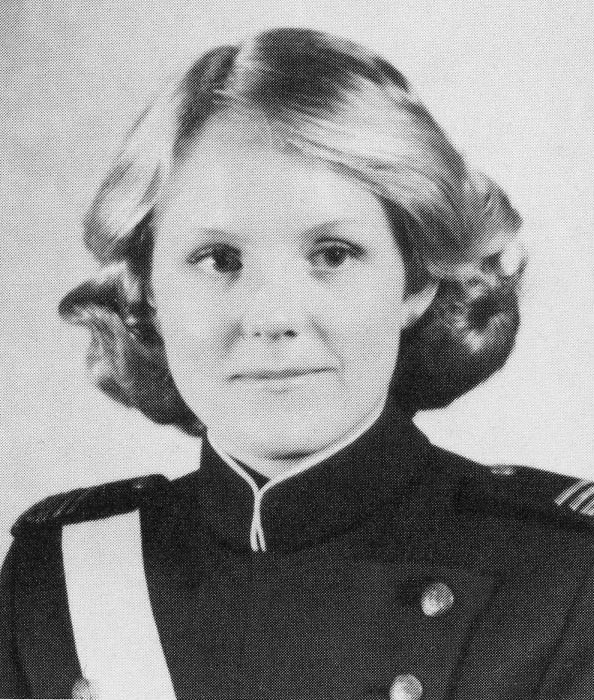
Virginia “Ginny” (Caine) Tonneson
As a junior in high school in Monument, Colorado, I first submitted an interest card to the Academy on a dare with my best friend, knowing that females were not allowed. I had never even thought of making the Air Force a career; I was more focused on going to a good university to swim, now that Title IX had passed. However, through a history writing assignment, a call from the USAFA swim coach, and reading about the legislative efforts to open the nation’s military academies to women, I decided that if boys could attend, why shouldn’t I?
A couple of months later, I received a letter from the Air Force Academy in response to my long-forgotten postcard. They politely told me that they are pleased I am interested in an Air Force career, but at this time they were not accepting females at the Academy. I should try ROTC or Officer Training School if I was interested in joining the Air Force.
A few weeks later, I was surprised to receive another letter from the Academy. This one said that Congress was considering legislation that “would permit young ladies to attend the academies” and that they said they were maintaining my name on file so that they could provide me information if the president signed the bill. They obviously didn’t know that I submitted my name as a joke.
I decided to go ahead and apply. Everyone around me seemed more excited about my application than I was. I used to live on the Academy, when my dad was a captain and major, and after all, it was the closest college to my home!
On Oct. 7, 1975, President Ford signed the bill which allowed women into the service academies starting in June 1976. By that time, I had already applied and had interviewed with the first of my senators as part of the nomination process. The process moved quickly after that, and when I received my appointment in early January 1976, I was told that I was the first female selected to USAFA. To manage the publicity, they held off on an announcement until six females had been appointed, and then my life changed completely. The press coverage was relentless — at least in the eyes of a 17-year-old girl.
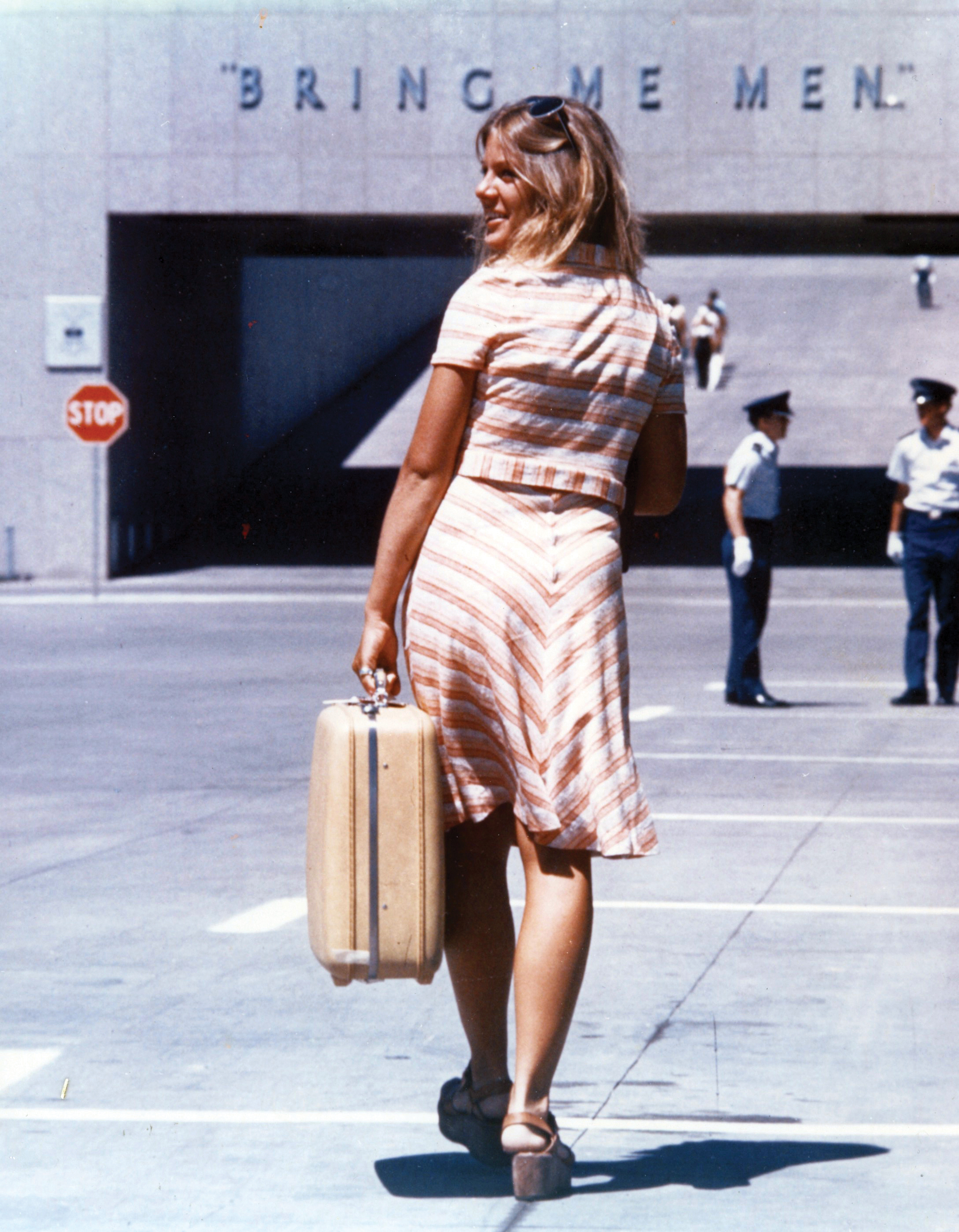
I got calls from People magazine, UPI, the Academy and local newspapers, and numerous TV stations. They asked me what I believed in and what I wanted to achieve at the Academy. What did I think of the “Bring Me Men” sign? How did I feel about going to an all-male school? What did I want to major in? Did I want to make the Air Force a career? I was totally blindsided by these questions, completely unprepared to answer. I came up with a few words on how I admired my father’s Air Force career and the military lifestyle, and I commented that the sign did not bother me because it meant “mankind.”
Over the next several weeks, the press coverage continued unabated. The newspapers were there when I talked to my liaison officer, at basketball practice, during classes, when I was working out, at the surprise going-away party my friends threw for me, and even as I packed the day before leaving for the Academy. The unwanted attention seemed never-ending to me.
I didn’t eat much breakfast the day I reported to the Academy, because I was so nervous. I just wanted to get the day over with. I then had one of the rudest awakenings of my life. The newspeople were not done with me yet. The camera crew was back, and they wanted to film me driving to the Academy. Worse yet, they wanted to ride in the same car as me! I didn’t know what to do. I wanted to have a last goodbye with my family, but that wasn’t to be. The cameraman sat next to me and had the camera in my face the entire drive. I just wanted to get out of the car and blend into anonymity.
We arrived at the Academy parking lot near the “Bring Me Men” ramp. My parents and the cameraman got out of the car with me. I remember being worried that the cadets would see me as some sort of attention-seeking female invading their all-male institution for the first time. I felt angry and upset that I had been put in this position on my first day. I knew I had every right to be there, and I didn’t want anyone to have any preconceived notions about me. I wanted them to know me for me! With not a clue about how my life was about to change and with only a quick glance back at my mom and dad, I stepped across the white line and began my first day.
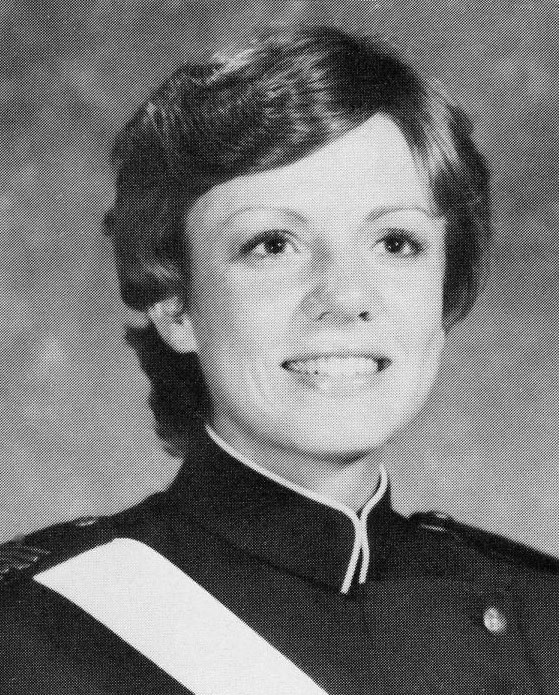
Marianne (Owens) LaRivee
In 1975, my father, an Air Force pilot, was stationed at the Pentagon. Legislation signed by President Ford allowing women to enter the nation’s military academies was big news among his co-workers. A close family friend, a Navy admiral and U.S. Naval Academy graduate, suggested that I apply to one or more of the academies (he was pushing USNA). He stressed the fine education and the excitement of forging new paths for women. After researching the missions of all the services, I decided to apply to USNA and USAFA.
The Washington Post and The Earlybird (the Pentagon’s internal newsletter) kept us abreast of the preparations each of the academies was making to admit and integrate women. The Air Force appeared to be taking the job more seriously and preparing for more contingencies, so I began to drift in that direction. On Feb. 10, I received my acceptance to USAFA, along with five other women across the nation. Kathy Bishop (another early appointee) and I were immediately contacted by The Washington Post and interviewed the next day. That’s when it hit home that we were not just representing our 17-year-old selves but were part of something larger.
That Washington Post article was a disaster. The female reporter kept asking me about my motivation for attending USAFA, inferring that it was going to be a great social environment for women since only 10% of the class would be female. I deflected her innuendos, stating that I was going for the academics, the opportunities, the chance to serve my country.
Later that spring, USAFA sponsored a meeting for prospective cadet candidates at Andrews Air Force Base, Maryland. Kathy and I, along with other area appointees, listened to cadets describe life at the Academy and how to prepare for Basic Cadet Training. They also said most officers and cadets were not in favor of women joining their ranks. They doubted that many women could make it in without concessions made for their strength or stamina. And they warned that any women admitted would face strong opposition once they arrived and would probably quit after realizing that they were neither welcome nor suited for the rigors of the Academy.
Well, that was a challenge. Such comments did more to strengthen my resolve than deflect it. I redoubled my training and preparation for BCT, following to the letter the suggested regime for running, push-ups, pull-ups and sit-ups. I was scared, but I was prepared.
*****
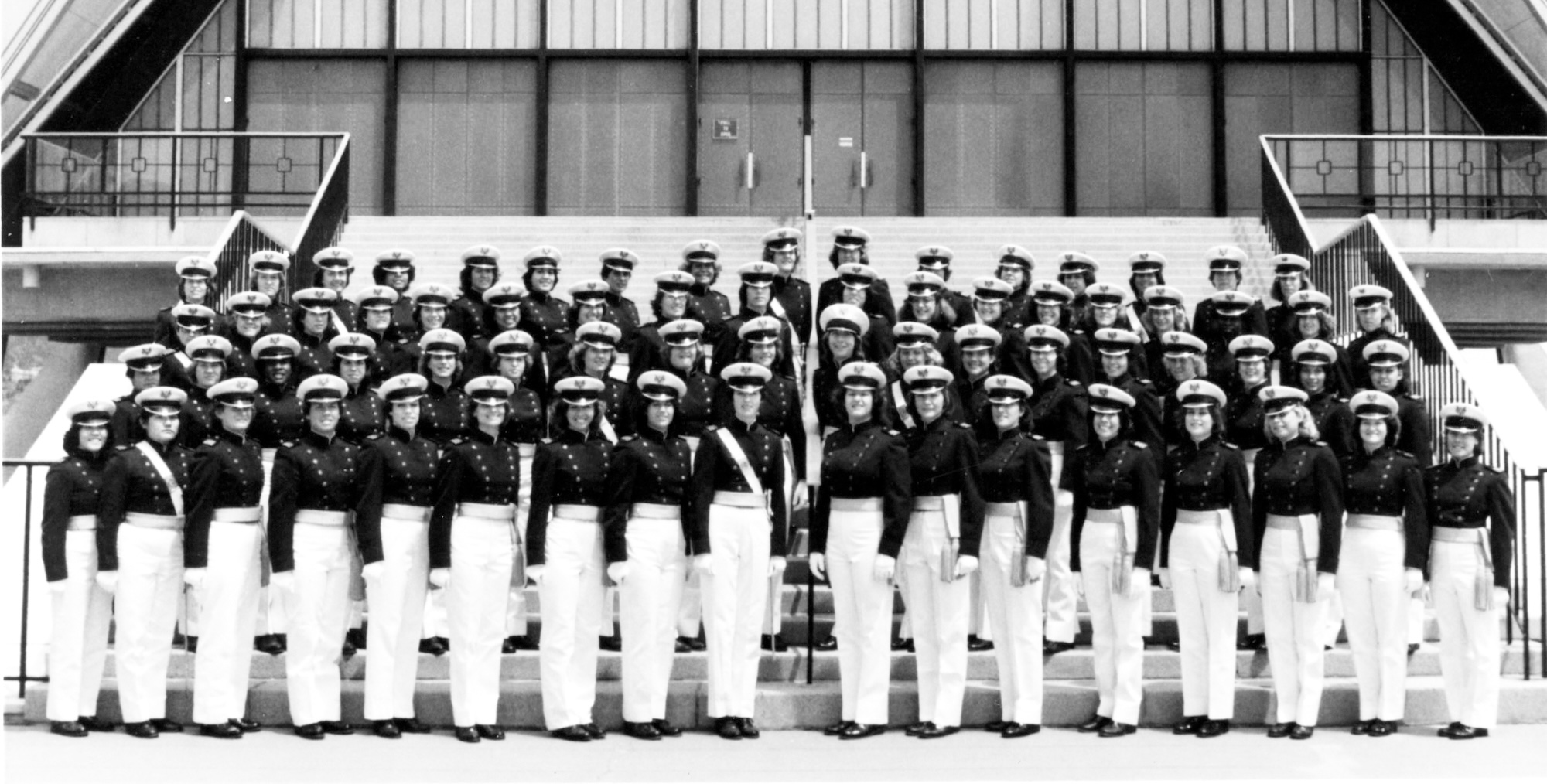
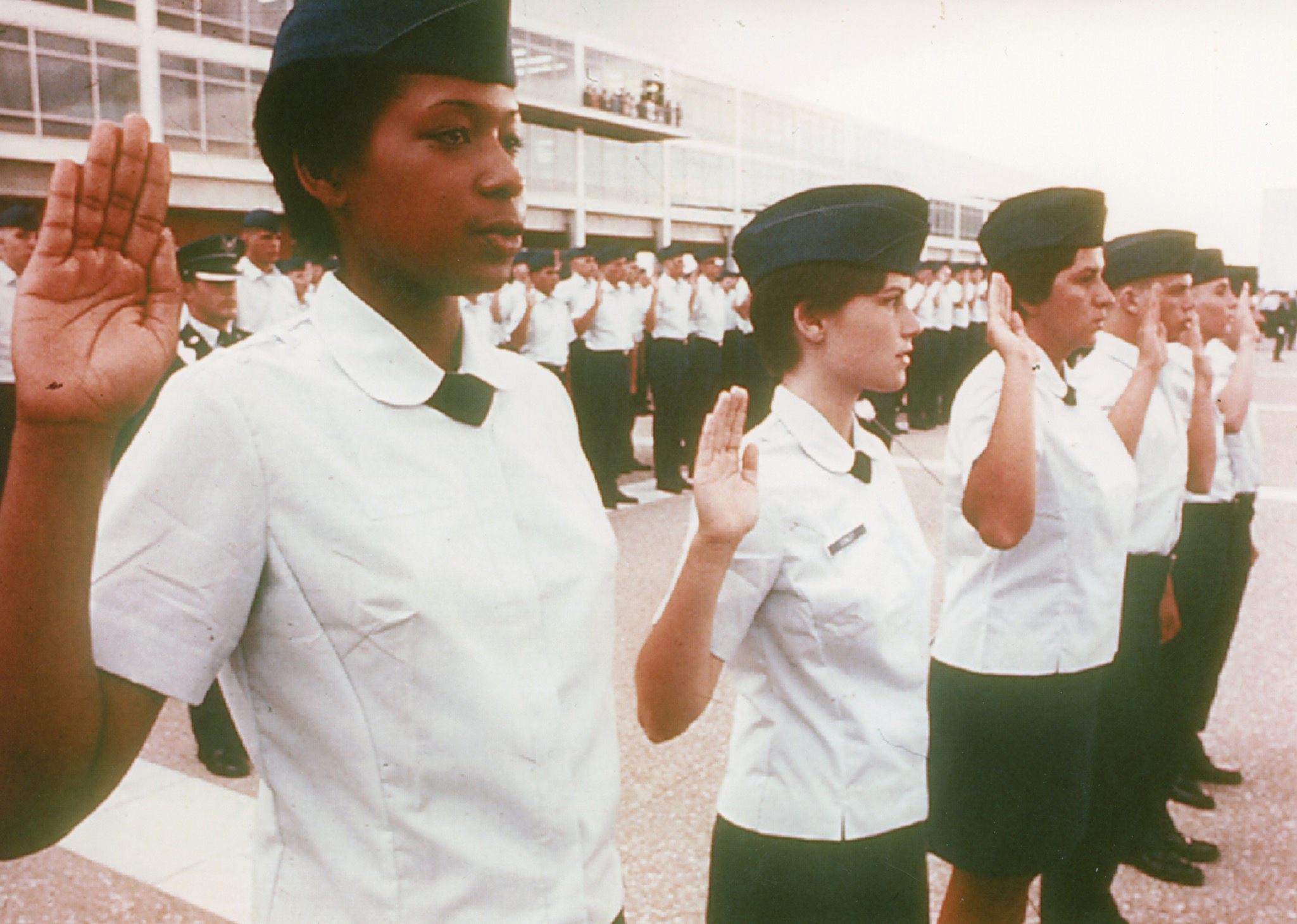
On June 28, 1976, Caine and Owens were among the 1,593 appointees, to include 157 women, to report to the Academy as members of the Air Force Academy Class of 1980. The most significant change in the Academy’s history was happening.
Editor’s note: The sections containing Brig. Gen. (Ret.) Philip D. Caine and Dr. Ginny Caine Tonneson’s comments are excerpted from Dr. Tonneson’s forthcoming book, Joining the Long Blue Line: The First Women at the Air Force Academy. Read more about the 50th anniversary of the incorporation of female cadets at the Academy in the June 2026 issue of Checkpoints.